


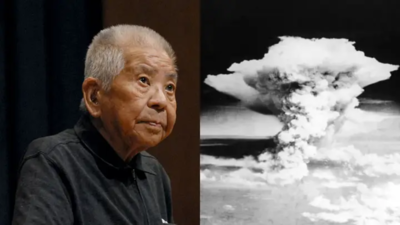
On August 6, 1945, Tsutomu Yamaguchi was preparing to leave Hiroshima and return to his family in Nagasaki when a blinding flash lit up the sky. The 29-year-old engineer was on a business assignment for Mitsubishi Heavy Industries, working on the design of oil tankers. Within seconds, the city was devastated by the world’s first atomic bomb used in warfare. Yamaguchi was thrown into the air, temporarily lost his sight and hearing, and suffered severe burns across his upper body.He managed to reach a railway station and spent the night in Hiroshima before making the journey back to Nagasaki. He had survived an atomic bombing and was finally home with his wife, Hisako, and their infant son. But the ordeal was far from over. Three days later, on August 9, as he reported for work and attempted to explain to his colleagues what he had witnessed, a second atomic bomb exploded over his hometown.Yamaguchi was among the people caught in both attacks. He survived the Hiroshima bombing and then the Nagasaki bombing, becoming the only person officially recognised by the Japanese government as a survivor of both. His story, however, was not one he readily shared for much of his life. It took decades for him to speak publicly about the experience, and he eventually became an advocate for a world without nuclear weapons.
‘I thought the mushroom cloud had followed me’
Yamaguchi was approximately three kilometres from ground zero in Hiroshima when the bomb, code-named Little Boy, detonated at 8:15 am. In an interview with ABC News in 2009, he recalled seeing a flash and hearing an enormous sound. “I thought the sun had fallen from the sky,” he said, describing the moment the explosion struck. His hair and face were burned, as was his upper body. He later recalled that only his legs remained capable of moving properly.After spending the night in Hiroshima, he managed to make his way back to Nagasaki on August 8. His injuries were treated, and his body was wrapped in bandages. Despite his condition, he returned to work the following morning. That was when the second explosion came. Yamaguchi was recounting the devastation in Hiroshima to his supervisor when another blinding flash filled the room. The United States had dropped the Fat Man atomic bomb over Nagasaki at 11:02 am on August 9.“I thought the mushroom cloud had followed me from Hiroshima,” he later recalled, describing his reaction to the second blast. He was around three kilometres from the Nagasaki explosion’s epicentre. His wife and young son also survived. The two bombings killed tens of thousands of people immediately and left many more suffering from burns, injuries and radiation-related illnesses. Yamaguchi himself experienced lasting health problems, including hearing loss in his left ear, according to contemporary reports.
Why he stayed silent for decades
Although his experience was extraordinary, Yamaguchi returned to his career after the war, working as an interpreter for the occupying US forces before becoming an English teacher and eventually resuming his engineering work at Mitsubishi. He also wrote poetry, including traditional Japanese tanka, and tried to rebuild an ordinary family life.His reluctance to speak about the bombings was partly rooted in the suffering he had witnessed around him. He felt uncomfortable drawing attention to his survival when so many people around him had become seriously ill or died. His daughter Toshiko Yamasaki later explained that the family had also worried that his relatively healthy appearance might lead people to underestimate the devastating effects of radiation exposure.According to ABC’s 2025 retrospective, Yamaguchi began speaking publicly about his experiences around 2005, after the death of his second son, who had survived the Nagasaki bombing as an infant but later died of cancer. His memories, once kept largely within the family, became part of a wider effort to preserve the experiences of atomic bomb survivors.He travelled to the United Nations in 2006 and spoke about nuclear disarmament. His message was shaped not by a desire to be remembered as a statistical exception, but by the belief that no one should have to experience what he had.
Officially recognised as a survivor of both bombings
For years, Yamaguchi had been officially certified as a hibakusha, the Japanese term for people affected by the atomic bombings. But his government record initially recognised his exposure in Nagasaki, not Hiroshima. That changed in March 2009, when Japanese authorities officially recognised him as a survivor of both attacks. At 93, he became the first person to receive this distinction.“My double radiation exposure is now an official government record. It can tell the younger generation the horrifying history of the atomic bombings even after I die,” he said, according to a report by The Japan Times.Historians estimate that around 165 people may have been present in both cities during the attacks. Yamaguchi, however, remained the only person officially recognised by the Japanese government as a survivor of both. He died in Nagasaki on January 4, 2010, aged 93, after being hospitalised with stomach cancer. His death was mourned by Nagasaki’s mayor, Tomihisa Taue, who described him as a valuable witness whose experiences had helped make the horrors of nuclear warfare known to the world.