


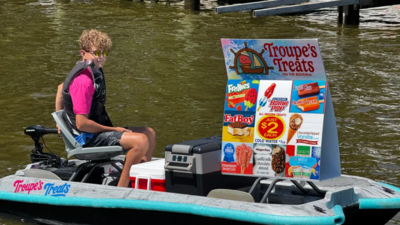
Sixteen-year-old Brian Troupe turned an unsuccessful pier-side business idea into a floating ice cream business on the Bohemia River in Maryland. By the end of the 2026 summer season, his boat-based business, Troupe’s Treats, had made more than $25,000 in gross sales. The young business owner started his journey at age 15 after a conversation with a neighbour gave him an idea. While they were out on the water, the neighbour mentioned that someone had once sold food to local boaters. Troupe enjoyed spending time on the water and saw a chance to earn some extra money while providing a service that few boaters could access during hot summer days. “I thought quite a bit about how I can kind of sneak past some food certifications and not have to have a sink on a boat and all of this extra equipment,” Troupe told Entrepreneur magazine. “And still having something that a lot of boaters don’t have on their boat.”
Setbacks on the shore
Troupe’s first attempt to sell ice cream did not go as planned. He set up a small shop at the end of a pier, hoping boaters would stop by to buy frozen treats. However, he did not make a single sale on the first day. Boat owners were unwilling to pull up their anchors and bring their boats alongside the pier. Looking back at that first failure, Troupe told Entrepreneur magazine that it felt like a lemonade stand that had failed. “It went the worst it could have,” Troupe said. “Luckily for me, I didn’t let that stop me.” After realising that customers were unlikely to come to him, Troupe decided to take his business directly to them. He spent around $700 of his own savings on a small jon boat. He also spent another $120 on boat bumpers and basic boating equipment. Rather than waiting at the pier, he travelled to boats anchored on the water and offered pre-packaged ice cream bars for $2 each. The new approach worked straight away. During his first weekend selling directly on the water, Troupe made around $400 in revenue. As the first summer continued, his business averaged $800 per weekend. His best weekend brought in more than $1,200, and he ended the season with almost $6,000 in gross sales.
Expansion and upgrades on the water
After seeing early success, Troupe expanded his business for the 2026 summer season. He moved from basic store-brand ice cream to more expensive products, including Magnum and Klondike bars. He also increased the price of each item to $3. To handle more customers, Troupe replaced his first boat with a larger Sea-Doo Switch pontoon boat and added a bigger freezer system. These changes allowed Troupe’s Treats to cover more areas. The business expanded beyond its original location and began visiting four different anchoring spots across local waterways. The expansion brought a major increase in sales. During the 2026 summer season, the business averaged $1,800 in revenue each weekend. Its highest single-weekend sales went above $2,100. By the end of the season, total gross sales had passed $25,000. Along with selling ice cream, Troupe also introduced his business to local community leaders. According to public records from the Cecilton Town Council, he presented his business model to the council in May 2026. At the time, he was also competing against 63 other participants in a statewide Maryland entrepreneurship contest, which had 64 participants in total.
Innovative operational techniques
Running a shop on open water came with several practical challenges. One of the biggest problems was handing products to customers on boats of different heights. Reaching passengers on larger boats was not always easy. “It becomes a comical scene,” Troupe explained to Entrepreneur magazine. To make deliveries easier, Troupe started using long-handled fishing nets with wide hoops. These nets allow him to reach passengers on larger boats and pass them up to six ice cream items at once. Customers then place their cash payments directly into the net. Troupe also came up with a simple way to manage cash payments and change. After increasing the price of each ice cream bar to $3, customers paying with $5 bills often needed two $1 bills in change. To avoid running out of single dollar bills, he began keeping $2 bills on hand to give customers as change. The teenager also offers free “pup cups” to boaters who bring their dogs along. This small extra service helps build good relationships with regular customers and makes the experience more enjoyable for their pets.
Future plans and industry advice
Looking ahead, Troupe plans to continue running Troupe’s Treats during future summer seasons while keeping his career options open. Although he enjoys owning and running a business, he has long been interested in engineering, especially designing roller coasters for theme parks. He is also open to handing the business over to another young person in the future. “I can even see myself, once I’m a lot older, passing [Troupe’s Treats] down to somebody to give another teenager the same opportunity that I had,” Troupe told Entrepreneur magazine. “Because this opportunity has really provided me with a lot of education, experience and a lot more than I could have ever thought.” When offering advice to other young people who want to start their own businesses, Troupe stresses the importance of not giving up when things go wrong. He believes young entrepreneurs should be ready to make mistakes and learn from them. His main advice is to always leave room for failure, pointing out that the first day at the pier, when he made no money at all, became an important step towards building a successful business.