


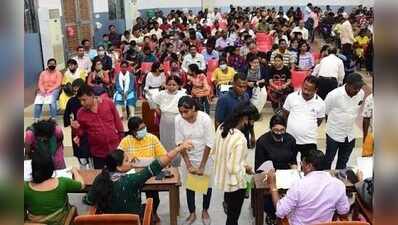
Bhubaneswar: Even as the state govt added over 10,000 more undergraduate (UG) seats across major streams this year, it is now struggling to fill up over 79,000 seats after the second phase of admissions for the 2026-27 academic session. The UG classes have already commenced in July-end.According to the higher education department’s Student Academic Management System data, 79,113 seats across seven streams have remained vacant after the second phase of admissions this month, with physical science and commerce having the highest proportion. There are seven streams in UG — self-financing courses, Sanskrit, law, arts, physical science, biological science and commerce — with a combined seat strength of 2,88,128 in 1,058 colleges.Phase II was conducted after three admission rounds under Phase I.Of the 79,113 vacant seats, 72,717 were in arts, physical science, biological science and commerce. The remaining 6,396 vacancies were in self-financing courses, Sanskrit and law.Arts accounted for the largest number of vacancies, although its vacancy rate was lower than that of science and commerce. Of the 1,66,196 arts seats available, 1,38,919 had been filled, leaving 16.4% of them vacant.Physical science, meanwhile, has the highest number of vacant seats, with 21,590 of the 46,197 remaining unfilled. Admissions stood at 24,607, leaving 46.7% of the total capacity vacant.Commerce recorded a similar trend. Of the 32,085 seats available, 17,181 had been filled, leaving 14,904 vacant. The vacancy rate stood at 46.5%.Biological science has 8,946 vacant seats against a total of 28,992. With 20,046 admissions, 30.9% of the seats are vacant.This is not the first academic year in which such a huge number of seats have remained vacant. While around 88,000 seats went vacant at UG level in 2024-25, 80,000 seats found no takers in 2025-26.Education expert R N Panda said students today are increasingly looking beyond conventional degree programmes towards technical and professional courses that offer specialised skills and clearer career pathways.“Subjects such as computer science, data analytics, healthcare, management and emerging technologies are attracting interest because students want their education to translate into employment opportunities. While traditional courses continue to have academic value, colleges may need to rethink their course offerings and strengthen industry linkages to match changing aspirations,” he said.