


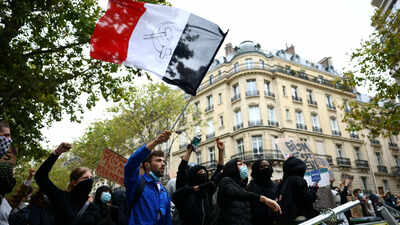
Violent clashes erupted in Paris on Saturday as police fired tear gas and used water cannons to disperse protesters during a nationwide march. Over 400,000 gathered to demonstrate against school underfunding and the rising cost of living, with unrest also reported in several other French cities.The procession brought thousands onto the streets and intensified pressure on French President Emmanuel Macron‘s government.Visuals from the streets of France showed the immense gathering of thousands of protestors holding banners in their hand to express their stance against the rising cost of living.However, what began as a peaceful procession through the French capital turned violent when thousands of demonstrators reached Porte de Vincennes, on the city’s southeastern outskirts. Visuals from the scene showed thick clouds of tear gas filling the streets as mask-clad protesters threw cobblestones and other projectiles at security forces.Police deployed armoured water cannons to push back groups of demonstrators in crowded areas. Separate footage showed shopfronts being looted and windows smashed, raising concerns after widespread rioting damaged more than 3,000 businesses across France the previous week.The Paris prosecutor’s office confirmed 64 arrests linked to Saturday’s protest. Forty people, including six minors, were held in custody, primarily on suspicion of weapons offences or intending to commit violence and damage property.
Unrest spreads across France as 70,000 officers deployed
Clashes were also reported in Lyon, Clermont-Ferrand, Strasbourg and Marseille, where police fired tear gas. Water cannons were used to disperse crowds in Nantes and Nice.The French interior ministry estimated that 410,000 people took part in the demonstrations nationwide, including 110,000 in Paris. The CGT trade union, however, put the national turnout at nearly 800,000.France’s interior minister Laurent Nuñez deployed 70,000 police officers and security personnel across France, supported by armoured vehicles and helicopters. The security operation followed the previous week’s unrest, when authorities acknowledged that police had lost control of several city centres.Security was tightened around major landmarks in Paris, including the Arc de Triomphe. The Louvre and Orsay museums, along with the Art Basel fair, also closed for the weekend as authorities sought to protect prominent venues from further violence.
Students, teachers demand better education facilities
The demonstrations began last month after complaints about staff shortages at a high school southeast of Paris. The movement has since expanded, drawing students, teachers and trade unions into a wider campaign against deteriorating public education and mounting financial pressures.Government figures show that public middle and high schools lost 15.4 million teaching hours during the 2024-25 school year because staff absences went unreplaced. As a result, 7.5% of scheduled class time was not delivered.Students are demanding 250,000 additional higher education places, changes to the Parcoursup university admissions system, a freeze on rents in public student accommodation and a monthly increase of 200 euros in grants.Economic concerns have added to the discontent. Energy prices rose 21.3% year-on-year in September, while overall inflation reached 3.1%, putting further pressure on households already struggling with the cost of living.
Protesters voice anger over inequality and lack of opportunities
The march brought together people from different generations and professions, many of whom said they feared the long-term consequences of inadequate public services and rising economic inequality.Camille Chesnier, 27, who has an engineering degree and a master’s degree but remains unemployed, described the difficulties faced by young people trying to find work and secure housing.“There are enormous numbers of people in the same situation as me but who aren’t privileged and who find themselves living on the streets and in squats and, frankly, it’s very tough.”Bénédicte Pittion, a 46-year-old teacher who marched alongside her 16-year-old daughter, Garance, said the young demonstrators had not received an adequate response from the authorities.“The young people who have been demonstrating have not been heard, and as a parent and as a teacher, I stand with them.”Garance said she felt “really scared” after the violence during previous weekend protests. However, she argued that staying home would allow the government to claim victory.Soumaya Abed, 58, a veteran nurse wearing a red CGT union vest, criticised the decision to push the march towards the outskirts of Paris.“They are using what happened last week as an excuse to quiet protesters. But it won’t stop the movement. It won’t stop students from demanding better conditions in schools.”Louis Ledoux-Xatard, another Paris protester, said growing economic inequality had left him concerned about the country’s future.“Looking at countries like the United States, we don’t want to end up like them, where part of the population has everything and the others have nothing. I never imagined that I’d be taking to the streets so much before my thirties.”
Macron faces mounting pressure as protesters reject concessions
The protests pose a fresh challenge to Macron, whose approval ratings have fallen to their lowest levels since he took office in 2017. The unrest comes in the closing months of his term, as discontent over public services and living costs continues to grow.Macron met student representatives on Friday and promised changes to university admissions. However, protest organisers rejected the offer as insufficient, signalling that the government’s response has done little to ease tensions.The movement has also drawn comparisons with the yellow vest protests, which began in 2018 over fuel taxes and expanded into a broader revolt against the cost of living and perceived economic inequality.The yellow vest movement has called for another national day of action on October 31 to defend the right to demonstrate, suggesting that the latest clashes may be part of a wider period of unrest rather than an isolated outburst.