


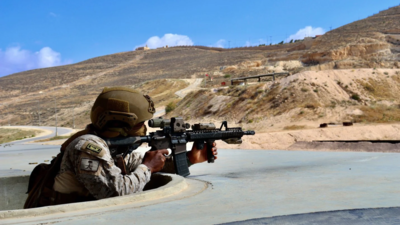
The Turkish government submitted the text of the Mecca Joint Defence Agreement to the country’s parliament, thereby revealing the text of the pact. The agreement, which was signed on August 7 by Saudi Arabia, Turkey and Pakistan. The tripartite agreement was signed in the midst of the conflict against Iran, which has engulfed the whole west Asian region at the receiving end of Tehran’s ire.The pact has a NATO style Article 5, which means that an attack on one country will be an attack on all. Article 2 of this agreement states that an externally originating armed attack against any party shall be considered an attack against all. The parties are to assist the attacked state immediately, deciding the scope and nature of support after an objective assessment of the assistance required, within their available resources, including military means.Article 1 commits the three nations to cooperate in safeguarding each other’s independence, sovereignty and territorial integrity and to use all necessary means to eliminate threats. The text does not name any country or region as a threat. It also affirms non-interference in internal affairs and the sovereign equality of the parties, and refers to Article 51 of the UN Charter.The pact has raised concerns in India, Israel and Greece. Pakistan’s nuclear arsenal gives the grouping deterrent weight, but it does not provide an automatic nuclear umbrella. On October 5, the three countries agreed in Riyadh to activate collective deterrence measures and provide forces for rapid deployment to Saudi Arabia after Houthi attacks. Pakistan had earlier deployed a military contingent, including fighter and support aircraft, to Saudi Arabia in April 2026 following the Strategic Mutual Defence Agreement.For India, the government has said it is examining the pact’s implications for national security and regional stability. The facts that bear on those implications are as follows. Saudi Arabia is an important partner for India, while relations with Turkey have periodically been strained over its position on Kashmir and its close defence ties with Pakistan. Indian analysts have pointed to Pakistan’s wider access to Turkish military technology as a concern. The Pakistani military had offensively used Turkish made Yiha suicide drones against India during the active phase of Operation Sindoor. The Pakistani military has procured high end drones from Ankara in the recent past.Saudi Arabia’s past record in India-Pakistan conflicts is also on the table. In the wars of 1965 and 1971 and in Kargil in 1999, Riyadh extended financial and diplomatic support to Islamabad but did not deploy forces against India. India’s commercial ties with the kingdom are substantial, covering trade, energy, investment and a large expatriate workforce. About 8.8 million Indian nationals live in the Gulf region, and the Gulf Cooperation Council (GCC) accounts for 15.4% of India’s total trade. Indian accounts say India and the council signed a free trade agreement in February.On the Pakistani side, its armed forces are committed along the Indian border and the Afghan frontier, to bloody counter-insurgency operations in Balochistan and in Khyber Pakhtunkhwa. At the same time situation in Pakistan Occupied Kashmir (POK) remains tense. Pakistan did not join Saudi-led operations in Yemen in the past, citing domestic sectarian sensitivities. The Houthis belong to the Shia sect and Pakistan has a considerable population of members of this branch. Pakistan is said to have the second largest number of Shia’s after Iran. The Pakistani military is stretched thin. Pakistani is said to have deployed around 8,000 troops in Saudi Arabia, along with a squadron of JF-17 Thunder fighters, two squadrons of drones and a Chinese-origin HQ-9 long-range air defence system.The members of this sect took to the streets and attacked the American consulate earlier this year as soon as the US attacked Iran. India has also kept up engagement with the UAE, Egypt, Israel and France, and has kept channels open with Iran.