


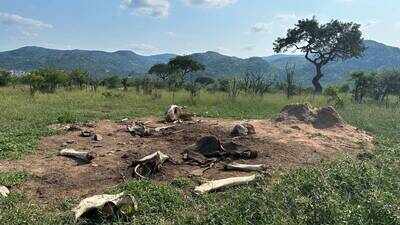
The death of an elephant may appear to mark the end of its role in the ecosystem, but new research suggests the animal can continue shaping its surroundings for years after its body has disappeared. Scientists have found that elephant carcasses create nutrient-rich hotspots that alter soil chemistry, influence plant growth and attract grazing animals long after the remains have decomposed.According to a study published in the journal Proceedings of the National Academy of Sciences (PNAS), soil nitrogen concentrations at freshly formed elephant carcass sites can be up to 3,000 times higher than expected. The effects can persist for at least eight years, revealing how the death of one of the savanna’s largest mammals can leave a lasting ecological footprint.An international team of researchers investigated elephant carcass sites in South Africa’s Kruger National Park, examining soil chemistry, microbial communities, plant diversity and grazing patterns around the remains. Their findings suggest that the ecological consequences of an elephant’s death extend well beyond the period during which its body remains visible.
How an elephant’s death inspired the research
The investigation traces its origins to 2009, when Alexander, one of Kruger National Park’s great tuskers, died of natural causes. The large bull elephant’s carcass lay near a road frequently travelled by study senior author Professor Dave Thompson, a biodiversity scientist at the South African Environmental Observation Network.Observing how the carcass decomposed over a period of months sparked his curiosity about its potential environmental impact. Thompson discussed his observations with Professor Deron Burkepile of the University of California, and their conversations eventually led to a wider investigation involving researchers and park rangers.Lead author Dr Courtney Reed of Princeton University explained that the death of a large animal immediately transforms the location where it falls.The elephant’s enormous body crushes vegetation, while scavengers feeding on the remains disturb the surrounding ground. As the carcass decomposes, the site can become a large patch of bare earth, effectively resetting the local plant community.Professor Burkepile noted that even an animal as large as an elephant can lose most of its visible flesh and remains within a matter of weeks. Yet the disappearance of the carcass does not mean its influence on the landscape has ended.
Soil nitrogen levels can rise up to 3,000 times
One of the most striking findings was the scale of the nutrient enrichment beneath recently formed elephant carcasses. As the remains break down, nutrients seep into the soil, changing its chemical composition and microbial activity.Reed said she had expected to find elevated nutrient levels at the sites, but described the magnitude of the increase as “jaw-dropping”. At the freshest carcass locations, soil nitrogen concentrations were found to be up to 3,000 times higher.The researchers also observed changes in the microbial communities living in the soil. These changes influence how nutrients are processed and how the surrounding ecosystem responds.However, the initial nutrient surge does not immediately lead to lush vegetation. Compounds such as ammonium can reach toxic levels, temporarily preventing plants from recolonising the ground.The team found that these sites could become biodiversity coldspots dominated by a relatively small number of fast-growing plant species. This pattern persisted for at least eight years after an elephant’s death.
Why elephant carcass sites attract grazing animals
Although plant recovery may initially be restricted, the vegetation that eventually establishes itself can be unusually nutritious. Tests of grass leaves revealed that the plants growing at carcass sites offer valuable forage to herbivores.Burkepile compared the transformation to turning watery iceberg lettuce into juicy romaine. The grasses may grow quickly, but grazing animals repeatedly feed on them, drawn by their nutritional value.The researchers observed herbivores returning to these locations for years after the elephants had died. Their droppings further replenish nutrients in the soil, potentially reinforcing the cycle of nutrient enrichment and grazing.This means the ecological legacy of a carcass is not limited to the nutrients released during decomposition. The animals attracted to the site can also contribute to its continuing transformation.To better understand how vegetation recovers without this additional grazing pressure, the team established fenced enclosures to keep herbivores away from selected carcass sites. Researchers hope the experiment will help them determine how grazing affects plant regrowth and the long-term development of these nutrient hotspots.
Elephant carcasses continue to shape the landscape years later
The persistence of these effects surprised some members of the research team. Izak Smit, a senior scientist at South African National Parks and a co-author of the study, had initially expected the impact to be relatively short-lived because the physical remains of an elephant disappear quickly.Instead, the researchers found that the soil and vegetation still showed a detectable carcass-related signal around eight years after an elephant’s death. Herbivores also continued to visit these sites more frequently than surrounding areas.The findings suggest that a carcass can leave behind an ecological footprint that outlasts its physical presence by many years.Researchers believe the strength and duration of this effect may depend on the surrounding environment. African savannas could represent a particularly favourable setting for such nutrient hotspots to persist.In wetter ecosystems, including forests and wetlands, heavy rainfall may wash nutrients away from the upper layers of soil. In deserts, limited water could restrict the ability of microbes and plants to use the nutrients released by decomposition.The researchers plan to continue monitoring carcass sites in Kruger National Park and are seeking collaborators elsewhere in sub-Saharan Africa to investigate whether similar patterns occur in other landscapes.