


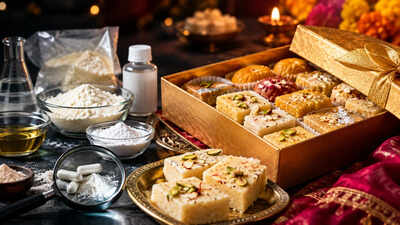
NEW DELHI: The box is gold-ribboned, the barfi is glossy, and the smell of ghee-laced sweetness is exactly what festive season is supposed to smell like. But what you are about to serve may owe more to a chemistry lab than a milk can.Real khoya is humble. According to FSSAI’s food product standards for dairy, it is made by rapidly drying cow, buffalo, goat or sheep milk, or milk solids. It must contain at least 55% total solids and at least 27% milk fat on a dry-matter basis, and it must be free of added starch and added sugar.FSSAI’s Guidance Note on Traditional Milk Products says that done right, it has a mildly cooked, boiled-milk flavour and a soft, granular body. Cow-milk khoya is pale yellow, while buffalo-milk khoya is white with a brown tinge.Fakes, enforcement officials say, are engineered to imitate exactly those qualities.
The recipe, as alleged

What’s inside your sweet box
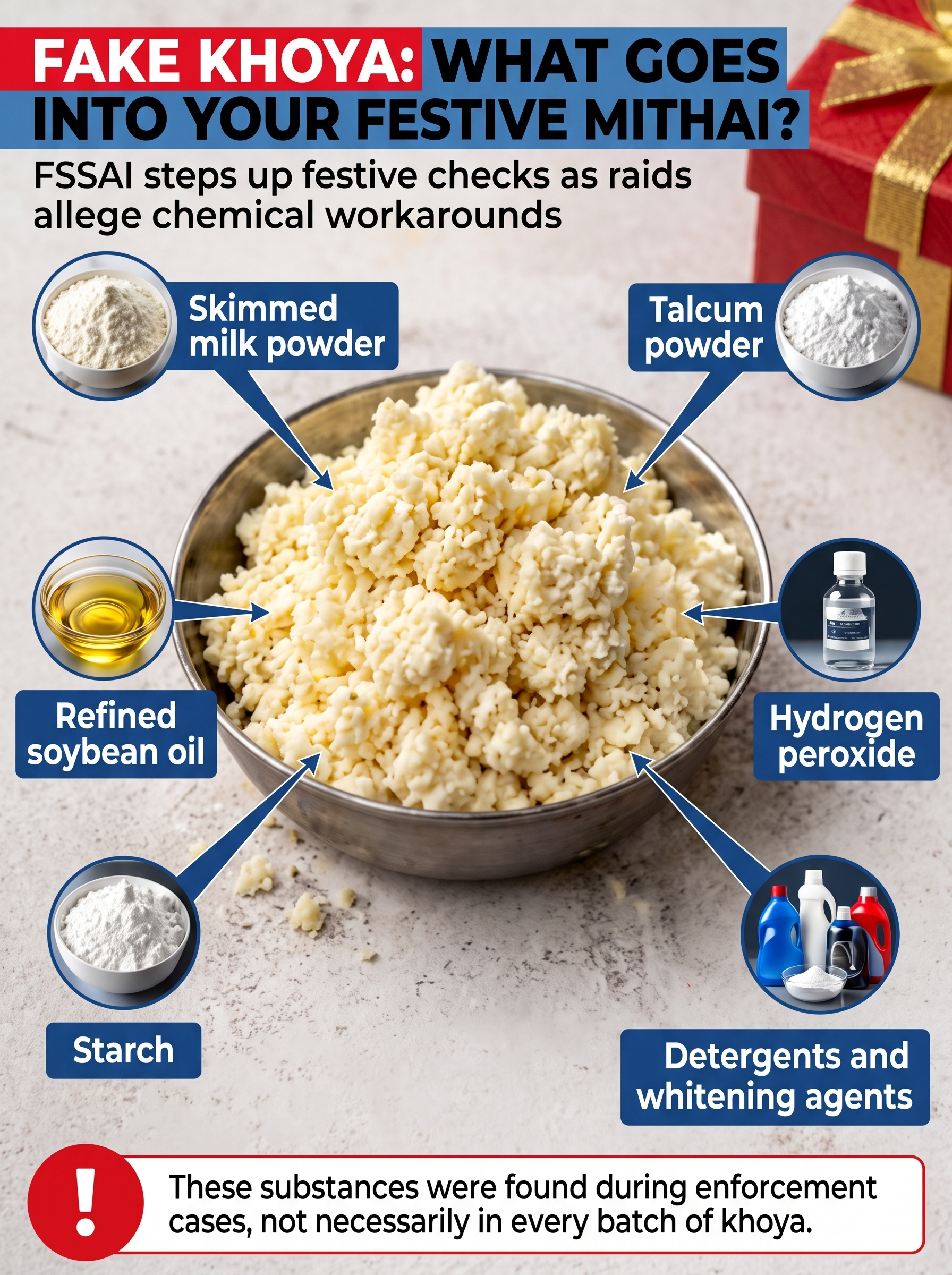
Consider the raid that Uttar Pradesh’s Food Safety and Drug Administration carried out ahead of Raksha Bandhan at a khoya unit in Badshahpur village, Rasoolabad, in Kanpur Dehat. UP food safety officials alleged that detergents, refined oil, talcum powder and hydrogen peroxide were in use.The team recovered 175 packets of skimmed milk powder in seven bags and about 15 litres of hydrogen peroxide. It also found saifolite, destroyed around 100 kg of prepared khoya, and collected samples of 50 litres of milk and 50 kg of khoya for testing.Read the list as a set of workarounds. Skimmed milk powder gives a cheap, milk-like base. Refined or soybean oil stands in for expensive milk fat. In a second unit at Bhola Nagar, Jhinjhak, the same department found 10 litres of refined soybean oil, 10 packets of skimmed milk powder and about 32 kg of prepared khoya.Starch, which FSSAI’s guidance note lists among khoya adulterants, adds bulk and density. Talcum powder is alleged to alter texture and appearance, and detergents are alleged to change smoothness and look. Hydrogen peroxide is a bleaching agent.UP officials said titanium dioxide and other whitening agents, liquid glucose, neutralisers and surfactants were also being used to make khoya and other dairy products.These remain allegations, and the samples are awaiting lab results. Not every sweet carries every adulterant. But the pattern is clear: bulk, fat, whiteness and texture, each faked separately and cheaply.
The cities connect

Food safety crackdown
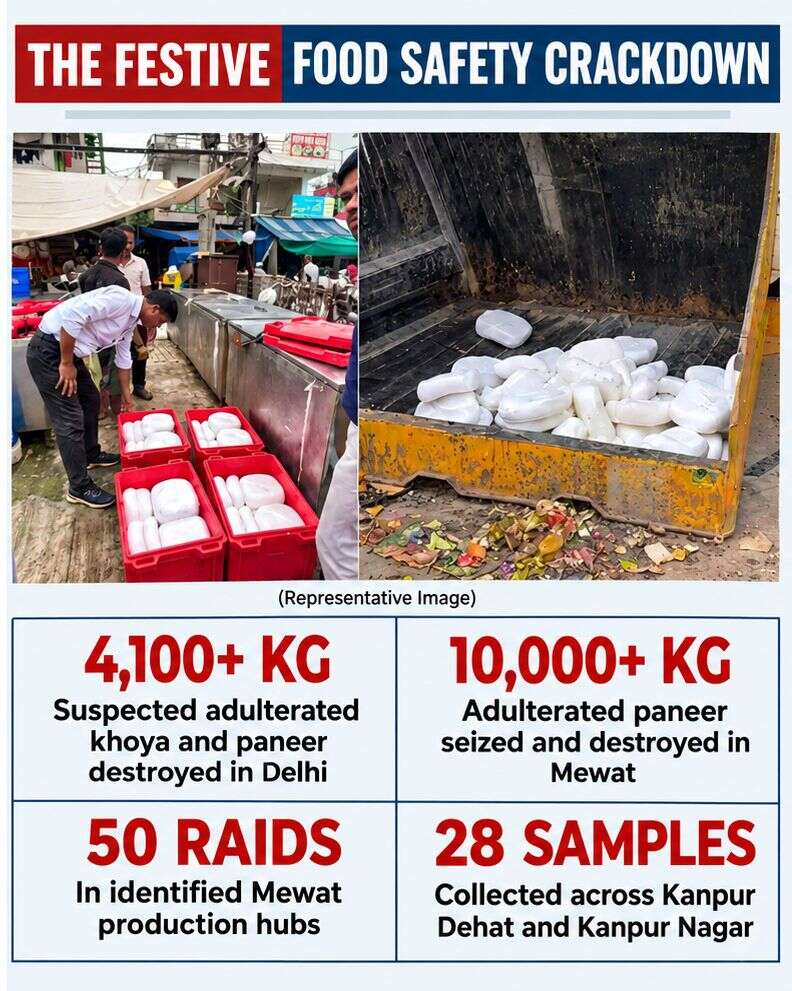
This is not a village-only story. On September 29, FSSAI directed all states and Union Territories to intensify inspections and sampling during Navratri and Diwali, flagging milk products, sweets, snacks, edible oil, beverages and ghee.Under that directive, Delhi’s food safety teams destroyed more than 4,100 kg of suspected adulterated khoya and paneer over the previous month, and samples of khoya, paneer, chhena and ghee are being drawn from city markets.Next door in Mewat, officials seized and destroyed more than 10,000 kg of adulterated paneer over the previous month, with around 50 raids in identified production hubs. They said the supply chain runs through Jaipur, Mathura, Gurgaon, Faridabad and Delhi, so what is made in one district can land on the mithai counters of another.Kanpur’s numbers, as reported by the UP food safety department, show the scale. Across Kanpur Dehat and Kanpur Nagar, 24 teams inspected units and collected 28 samples, destroying material with an estimated face value of Rs 1.50 lakh.At Hatiya Khoya Mandi, 14 samples were taken and about 430 kg of khoya worth Rs 1.07 lakh was destroyed for unhygienic storage. An FIR was registered at Rasoolabad police station under Sections 274 and 275 of the Bharatiya Nyaya Sanhita, and action to suspend or cancel the registrations of three food business operators has begun.In Noida and Ghaziabad, too, food safety teams have stepped up inspections of milk products and sweets this festive season.
A dose of perspective

How to check your mithai
Not every box is a hazard. FSSAI’s pilot survey of milk products in and around Delhi, conducted between October 15 and November 7, 2019, tested 1,041 samples (438 packed, 603 loose) at the National Food Laboratory, Ghaziabad.According to the regulator’s guidance note, the samples showed no major chemical or microbiological safety issues, but predominantly quality and hygiene problems, more often in loose products than in packed ones.Health experts caution that harmful starch, urea-mixed milk, caustic soda and non-approved colours can contribute to acute gastritis, diarrhoea, dysentery, dehydration and kidney inflammation.
What you can do
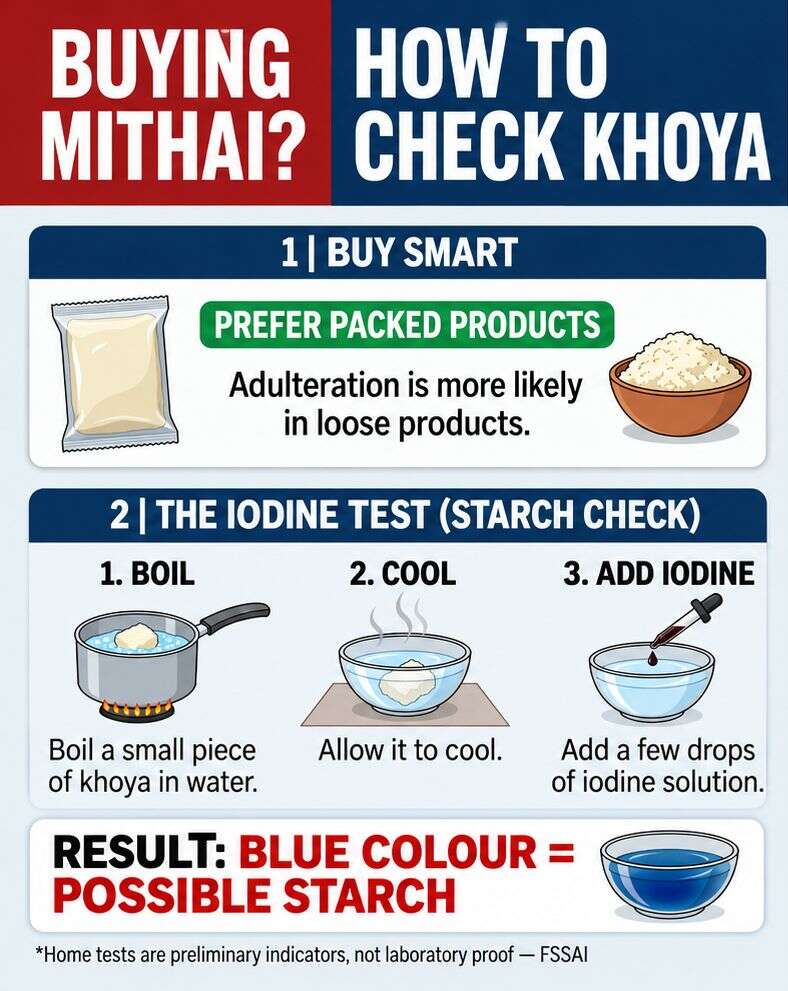
FSSAI advises consumers to prefer packed products over loose ones, since the probability of adulteration is higher in loose sales. Its guidance note describes a simple starch check: boil a small piece of khoya in water, cool it and add a few drops of iodine solution.A blue colour indicates starch. FSSAI itself treats such home tests as preliminary indicators, not laboratory proof.If something seems off, FSSAI says complaints can go to its Food Safety Connect portal, WhatsApp 9868686868, email compliance@fssai.gov.in, or toll-free 1800112100.Authorities have been directed to log inspections, sampling and outcomes in real time on FoSCoS and FoSCoRIS.As the Press Information Bureau has noted, FSSAI runs special drives before and during festivals, prioritising adulteration-prone products such as ghee, khoya, paneer and sweets.Until those lab reports land, the festive rule is simple: look past the ribbon.