


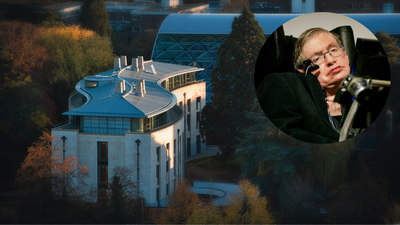
Stephen Hawking spent an important period of his life at a Victorian villa at 5 West Road, Cambridge, a property owned by Gonville & Caius College. Hawking and his first wife, Jane, moved there with their children in 1975, after the stairs at their previous home became increasingly difficult for him to manage as his motor neurone disease progressed. Caius adapted the property for wheelchair access, allowing him to continue his academic work while raising his family. The house also became the place where he wrote A Brief History of Time, the 1988 book that introduced complex ideas about cosmology to millions of readers. Years later, the villa was demolished and replaced by the Stephen Hawking Building, creating a lasting physical connection between the Cambridge site and his scientific legacy.
Stephen Hawking moved to the West Road villa in 1975
Hawking and Jane had bought a townhouse in Cambridge in the late 1960s, but the stairs became increasingly difficult for him to manage as his condition progressed. In 1975, the family moved to 5 West Road, a house owned by Gonville & Caius College. The college adapted the Victorian property for Hawking’s wheelchair, providing what Caius described as “lateral living”. Its large garden also gave their three children, Robert, Lucy and Timothy, space to play. The house allowed Hawking to balance family life with his demanding academic career. By then, he already had a strong connection with Caius. He became a Fellow in 1965, a year after receiving his PhD, and remained associated with the college for more than five decades.
The house became the place where A Brief History of Time was written
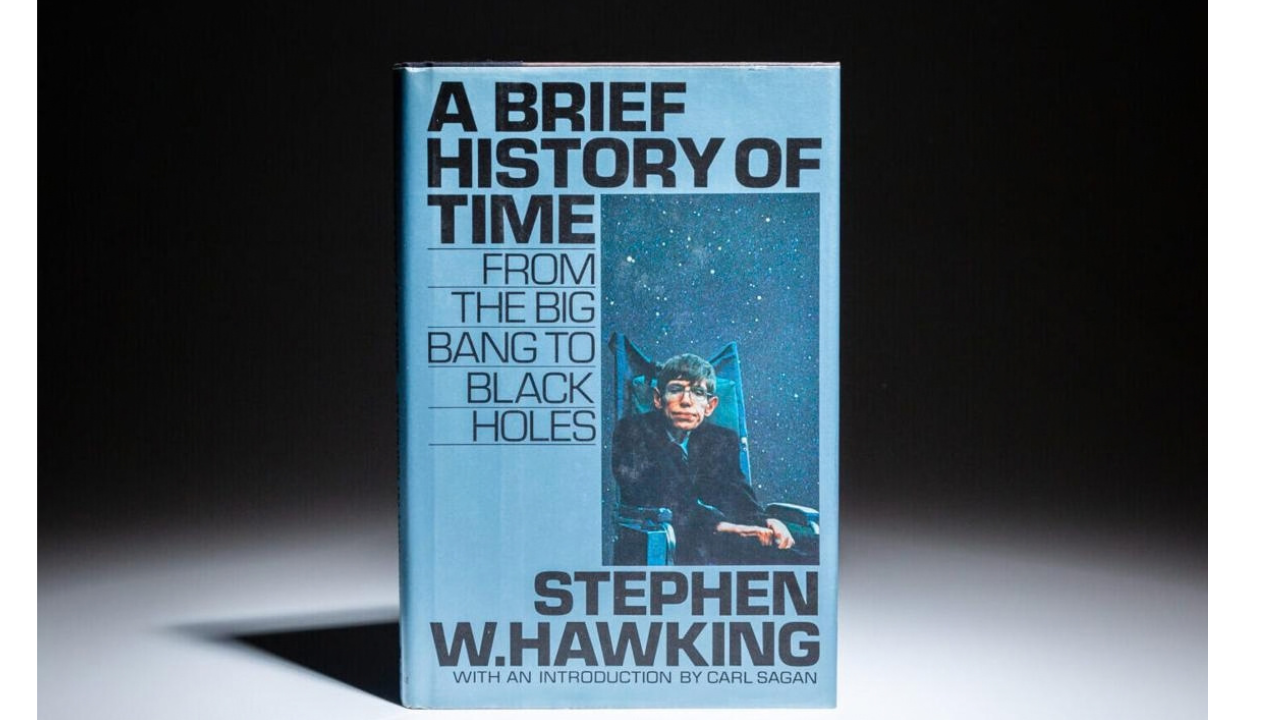
The connection between the house and Hawking’s most famous book comes directly from the physicist himself. In a 2015 speech at Gonville & Caius marking 50 years as a Fellow, Hawking recalled the property and said that he had written A Brief History of Time there. Published in 1988, the book explored some of the biggest questions in modern physics, including the origins of the universe, the nature of time, black holes and the laws governing the cosmos. Hawking presented these ideas for readers without specialist knowledge, using accessible explanations to explore how scientists had developed theories about the universe and its origins. The book became an international bestseller. Gonville & Caius says it eventually sold around 20 million copies worldwide, making Hawking one of the most recognisable science writers of his generation.

Caius adapted its buildings around him
The changes to Hawking’s home were part of a broader effort by Gonville & Caius to ensure that he could remain involved in college life. The college installed a lift and adapted its historic buildings so that Hawking could attend meetings, dine in Hall and take part in college activities. These changes enabled him to remain an active member of the academic community as his physical condition deteriorated. With that support, Hawking continued his research and writing while maintaining his connection with the college and its students and Fellows.
A medical crisis changed how he communicated
In 1985, Hawking developed severe pneumonia while in Switzerland. His condition became critical, and doctors asked Jane whether life support should be withdrawn. Caius arranged and funded a specially chartered flight to bring him back to Cambridge, where he was treated at Addenbrooke’s Hospital. He underwent a tracheotomy and lost his natural speaking voice as a result. Hawking subsequently relied on computer-assisted technology and a speech synthesiser to communicate. Although the change fundamentally altered the way he interacted with others, he continued his research, writing and public work for decades.
The Victorian villa was replaced
The house at 5 West Road eventually made way for a new college accommodation building. Gonville & Caius named the structure the Stephen Hawking Building, preserving the physicist’s connection with the site. The redevelopment took place while Hawking was still alive. In February 2005, he cut the first sod to mark the beginning of construction. A foundation stone was unveiled later that year, and the building was completed in 2007. The redevelopment transformed the site from a private family residence into part of the college’s accommodation facilities while retaining its connection with one of Caius’s most celebrated Fellows.
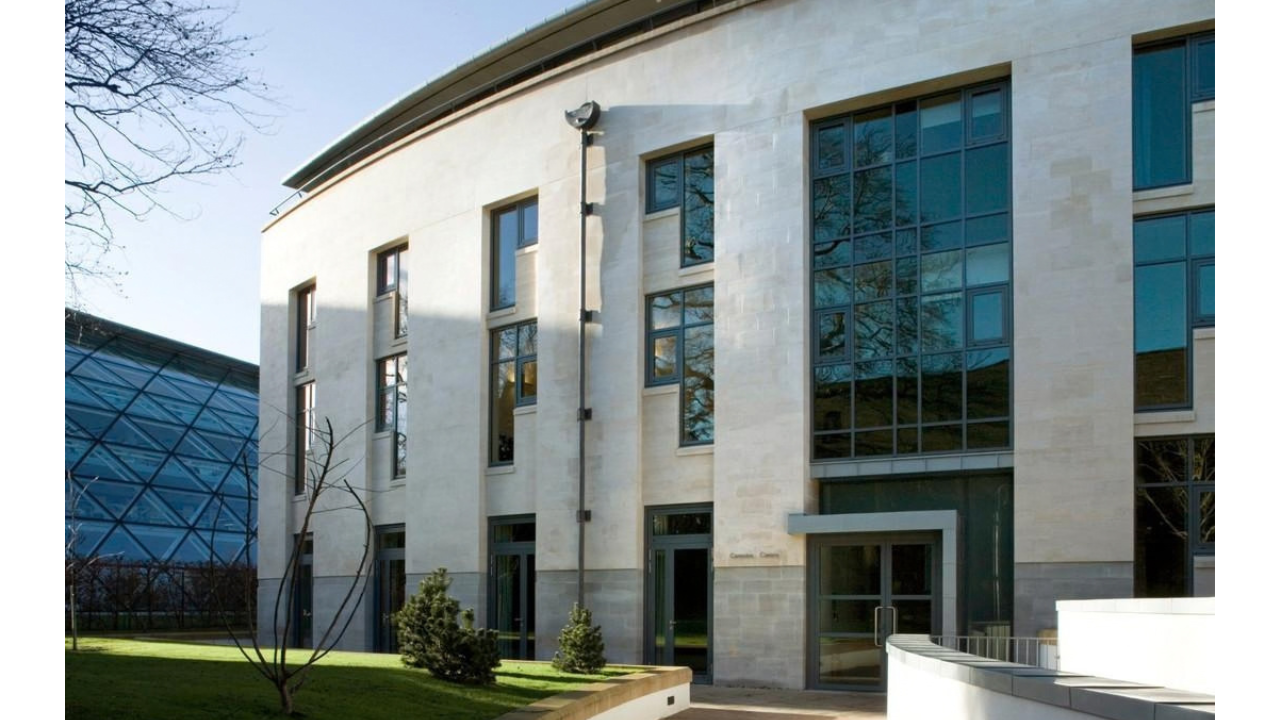
The Stephen Hawking Building
The building has 75 undergraduate rooms
The Stephen Hawking Building now forms part of Gonville & Caius College’s accommodation. According to the college, it contains 75 undergraduate rooms, along with eight Fellows’ sets and three supervision rooms. The project cost more than £10 million and received donations from more than 2,000 Caians, parents and friends of the college. The building also has a distinctive S-shaped design. Its unusual form was influenced by mature trees on the site that planners wanted to preserve, requiring the architects to shape the structure around them.
The site preserves an unusual part of Hawking’s legacy
Hawking died in 2018, aged 76, after more than five decades as a member of Gonville & Caius. The Victorian villa where he lived with his family no longer stands, but the site remains closely connected with his life. He lived there during a crucial period of his career, wrote A Brief History of Time there and later watched construction begin on the building that would carry his name.The story of 5 West Road brings together the personal and intellectual sides of Hawking’s life. It was a family home adapted to accommodate his disability, the place where he wrote one of the most influential popular science books of the 20th century, and eventually the site of a permanent tribute to his contribution to science.