


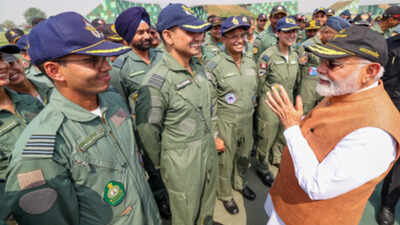
President Droupadi Murmu, Prime Minister Narendra Modi and Union home minister Amit Shah on Thursday extended greetings to the country’s air warriors, veterans and their families, while highlighting the Indian Air Force’s courage, professionalism and combat preparedness.The IAF marked its 94th Air Force Day, commemorating 94 years since the force was established on October 8, 1932.President Murmu said the IAF has rendered exemplary service to the nation and specifically praised its role in Operation Sindoor, saying the operation demonstrated the courage, precision and operational preparedness of Indian air warriors in safeguarding national security.“Operation Sindoor demonstrated the courage, precision and operational preparedness of our air warriors in safeguarding the nation’s security,” Murmu said.Prime Minister Modi said the country was proud of its air warriors and saluted their courage and commitment to protecting India’s skies.“India is proud of our Air Warriors. On Air Force Day, we salute their courage and commitment to protect our skies,” Modi said.Amit Shah described IAF personnel as “warriors of our skies”, praising their valour, precision and striking capabilities while paying tribute to those who laid down their lives for the nation.“A legion of real-life bravehearts whose saga of invincible valour, laser-sharp precision and devastating striking capabilities is testified by the Earth and satellites in faraway space,” Shah said.Evolution of the Indian Air ForceThe Indian Air Force has evolved from a small air arm established in 1932 into a modern aerospace force with capabilities spanning air superiority, precision strike, air defence, surveillance, strategic airlift and humanitarian operations.Established on October 8, 1932, as the Royal Indian Air Force, it began with a small fleet and limited operational capability. The force expanded considerably during World War II, gaining combat experience in the Burma theatre.After Independence in 1947, the IAF became a crucial part of India’s defence architecture. It played a major role in the 1947-48 Kashmir conflict and subsequently underwent significant modernisation. The 1962 war with China and the 1965 India-Pakistan war highlighted the need to strengthen India’s air power and develop greater self-reliance.Over the following decades, the IAF inducted platforms such as the MiG-21, MiG-23, MiG-27, Jaguar and Mirage 2000, while India also began developing indigenous aircraft, including the Tejas.During the 1999 Kargil conflict, the IAF conducted Operation Safed Sagar, with Mirage 2000 fighters carrying out precision strikes against Pakistani positions in difficult mountainous terrain. The operation demonstrated the growing importance of precision air power.In the 2000s and 2010s, the IAF further expanded its capabilities with platforms such as the Su-30MKI, upgraded Mirage 2000s, C-17 and C-130J transport aircraft and Apache attack helicopters.Today, the IAF operates a mix of Rafale, Su-30MKI, Tejas and other combat aircraft, supported by airborne early-warning systems, transport aircraft, helicopters, drones, air-defence systems and precision weapons.Its modernisation is increasingly focused on indigenous platforms, long-range precision strike, unmanned warfare, integrated air defence and network-centric operations.