


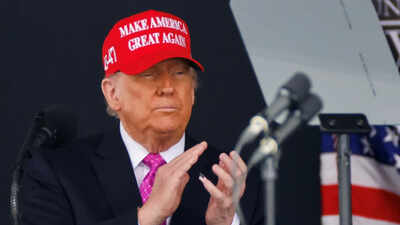
The TOI correspondent from Washington: Not too long ago, MAGA boss Donald Trump said foreign graduates should leave American universities with a green card “as part of your diploma.” Forget the green card; on Wednesday, his administration, under pressure from the nativist MAGA base, proposed a $70,000 fee to let those graduates work in America.Under a Department of Homeland Security (DHS) proposal scheduled for publication Thursday, US universities and colleges would have to pay $70,000 for an F-1 student’s first participation in Optional Practical Training (OPT) and another $30,000 for a subsequent authorization, including the 24-month extension STEM graduates are eligible for. The maximum charge over the standard 36-month STEM OPT period would therefore be $100,000. The proposal is not yet in effect and is subject to public comment.The legal obligation to cough up $70k OPT fee would fall on the university or other SEVP-certified school, not directly on the student. But as per the proposal, USCIS will not approve the student’s work authorization without payment. DHS nevertheless says schools could recover the cost from students, employers or other sources, which would effectively mean the nominally “school-paid” fee could ultimately become a charge on the student.This makes the proposal potentially far more than an immigration-fee adjustment — it could mean the end of inflow of foreign students who want to gain work experience in the US after their studies. OPT is routinely the first step into the American labor market for foreign graduates – including for the likes of Microsoft’s Satya Nadella and Google’s Sundar Pichai – before they seek an H-1B specialty-occupation visa. Roughly 418,000 students had OPT work authorization in 2024, more than a quarter of F-1 students.India is likely to feel the proposal disproportionately, considering it sent 363,019 students to US institutions in 2024-25 — roughly 31% of all international students — making it the largest source country. Indian participation in OPT reached 143,740, up 47% in one year. Almost half of Indian students were graduate students, and India’s students are heavily concentrated in computer science, mathematics and engineering. STEM graduates can remain in OPT for as long as three years.The new fee proposed by the Trump administration is not the end of foreign-student inflows — students can still study in America without OPT and many who are ready to return to their home countries as soon as they complete studies will still come. But if universities — many already under financial strain amid dwindling foreign admissions — conclude that paying $70,000 per student is untenable, prospective students, especially those choosing expensive STEM graduate programs partly because they expect US work experience, may increasingly choose Canada, Britain, Australia or other destinations.The proposal comes as the administration argues that OPT has become a “back door” into the American workforce. DHS cites fraud, abusive worksites and “pay-to-stay” schemes and says the enormous fee would force schools to exercise greater scrutiny over employers and students. The administration’s broader immigration policy makes the rationale clear: it argues that foreign labor, particularly lower-paid labor supplied through outsourcing companies, can displace Americans and suppress wages.There is genuine evidence of abuse in parts of the temporary-worker system. The Labor Department’s inspector general has launched investigations into alleged H-1B fraud and wage-kickback schemes, while DOJ this year settled a case involving a company accused of improperly excluding US workers from jobs advertised for H-1B, OPT and H-4 workers.But the larger MAGA argument — that foreign graduates are broadly unnecessary because Americans can fill these jobs — is much harder to reconcile with the structure of the US STEM workforce. According to the National Science Foundation (NSF) 22% of America’s 36 million STEM workers were foreign-born in 2023. Among workers in science and engineering occupations, the foreign-born share is substantially higher at advanced degree levels. Temporary-visa holders earned 38% of US science-and-engineering master’s degrees and 39% of doctorates in 2023. India is particularly important: Indian-born workers accounted for more than 727,000 of America’s foreign-born S&E workforce.This does not prove that every OPT worker is indispensable — or that every claimed shortage is real. Indeed, the STEM labor market is not uniformly tight. But it does demonstrate that the US does not currently produce all of the advanced STEM talent its research universities and technology industries consume.Ironically, it was not long ago that there was broad bipartisan enthusiasm for the US retaining foreign graduates, including from MAGA boss Donald Trump, whose administration is now tightening the screws on international students and foreign workers. Barack Obama and Hillary Clinton backed versions of the idea of effectively “stapling” green cards to advanced STEM degrees. Republican Presidential candidate Mitt Romney made a similar proposal in 2012. And Trump himself, in 2024, went considerably further, saying: “You graduate from a college, I think you should get automatically, as part of your diploma, a green card.” He explicitly included two- and four-year colleges and junior colleges.Silicon Valley too has long plugged for OPTs and H1Bs. Elon Musk publicly defended H-1Bs during a December 2024 clash with MAGA activists, saying the program was essential to recruiting talent. “Take a big step back and F**K YOURSELF in the face. I will go to war on this issue the likes of which you cannot possibly comprehend,” Musk raged as MAGA nativists drummed up a campaign against H1Bs and OPTs. The fight exposed a fundamental tension inside Trump’s coalition: nationalist immigration restriction versus the technology industry’s demand for global talent. Musk has since been far less publicly prominent as an advocate for H-1B expansion, while Trump himself has been tamed and tutored on the issue by nativist MAGA hardliners.For Indian students in particular, the message is stark: America may still welcome you into its universities, but the administration is proposing to make the transition from classroom to US workplace very expensive. Whether that protects American workers or drives some of the very talent America has spent years and billions of dollars educating to its competitors will be the central question of the coming years.