


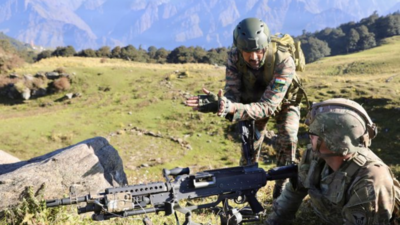
The army has held military exercises with four different counterparts from four different nations at virtually the same time. Exercise Yudh Abhyas, the 22nd edition of India’s bilateral drill with the United States, was underway across Mahajan field firing range in Rajasthan and Auli in Uttarakhand, bringing in Arctic-trained American soldiers from Alaska’s 11th Airborne Division for the high-altitude phase near the Line of Actual Control. Days apart, Exercise Mountain Guardian 2026 began with the UAE at Chaubatia in Uttarakhand, focused on mountain warfare and drone operations between a Bhairav Battalion contingent and UAE’s Mountain Infantry Battalion. Further north, the ninth edition of KAZIND with Kazakhstan is being held at Oskemen, with a 60-member contingent drawn mainly from the Garhwal Rifles. And this week, the 18th edition of Exercise Nomadic Elephant with Mongolia concluded at Pithoragarh.Running several of these wargames almost simultaneously reflects how far Indian military diplomacy has evolved. For decades, India’s defence partnerships were shaped by Cold War-era non-alignment, keeping formal engagement deliberately limited. That has changed substantially. Bilateral exercises now serve as working tools of foreign policy, letting India build interoperability across a wide range of militaries.Exercising with the US validates India’s deepening defence-technology relationship, while the drills with the UAE reflect the growing defence relationship between the two strategic partners. KAZIND keeps India engaged with Central Asia, while Nomadic Elephant sustains cooperation with Mongolia, a country wedged between China and Russia that has consistently sought to diversify its partnerships.Hosting these exercises on Indian soil carries its own advantages. It lets a far larger number of Indian troops get exposed to tactics, techniques and procedures of these militaries as well as exposure to equipment. It allows India to control the terrain and objectives of the exercise, tailoring drills to test its own tactics. The drills also signal confidence and capability to visiting militaries, reinforcing India’s position as a credible security partner rather than simply a participant.A source in the army has said Exercise Indra, India’s biennial exercise with Russia, is to be held later this year, though an official date has not yet been announced. This isn’t limited to these engagements either. The Army regularly exercises with other major militaries too, including France, the United Kingdom and Japan, while the Navy and Air Force run their own parallel exercises such as Malabar with the US, Japan and Australia.These exercises deliver direct military value. They expose Indian troops to different equipment, doctrines and combat environments, build interoperability at different levels and offers an opportunity to display indigenous systems to foreign militaries. For a country whose strategic autonomy is frequently tested by its neighbourhood, the ability to exercise simultaneously across such a varied set of partners demonstrates the room India has built for itself on the world stage.