


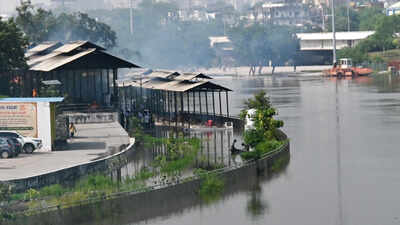
LUCKNOW: The state capital has witnessed flooding in several neighbourhoods over the past few days, but officials say the waterlogging is not solely the outcome of local rainfall. Instead, it is the downstream result of an eight- to 10-day movement of runoff generated nearly 250km upstream, where exceptionally heavy rain across Gomti catchment travelled gradually to the state capital.On Monday afternoon, Gomti was measured at 106.99 metres at Hanuman Setu, below the danger mark of 109.50 metres and far below the historic high flood level of 110.85 metres recorded in 1971.Despite that, low-lying colonies including Faizullahganj, Ghaila, Daud Nagar and nearby areas remained inundated, highlighting how delayed river response and floodplain encroachment can trigger urban flooding even when river levels and discharge are not at record highs.

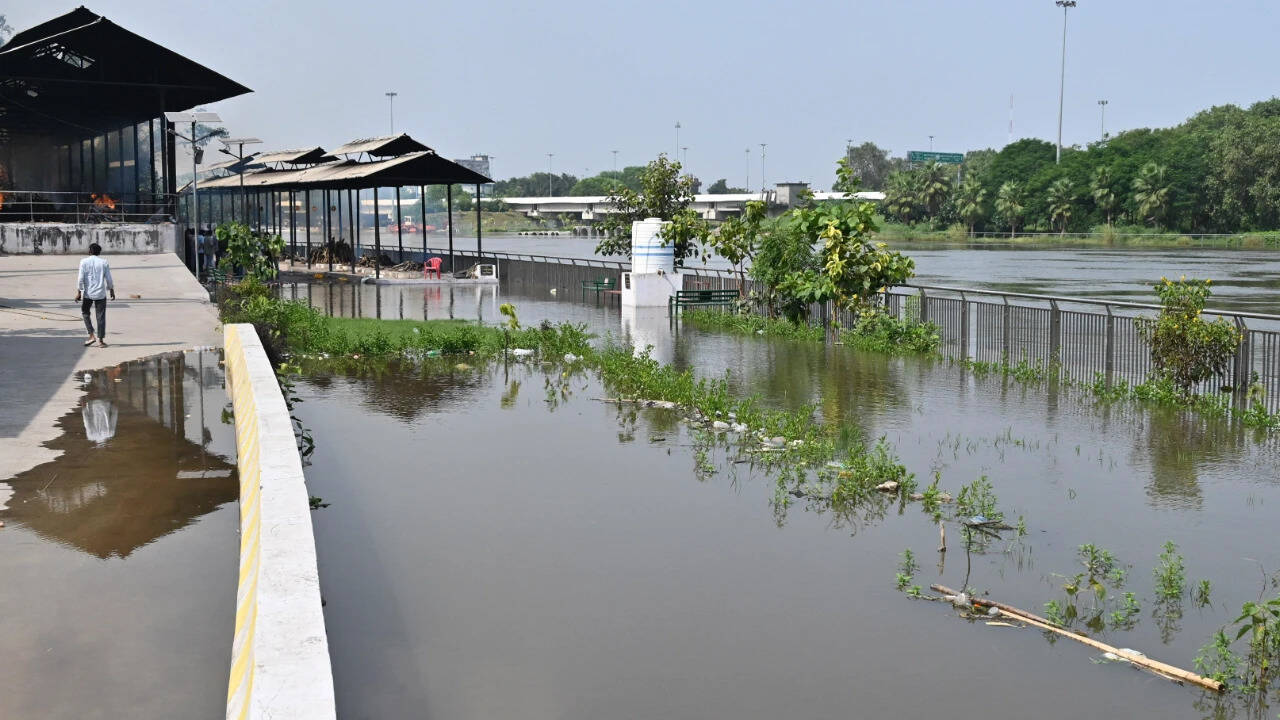
Rising Gomti levels at Baikunth Dham area of the Lucknow
Gomti originates at Gomat Taal in Pilibhit and flows through Shahjahanpur, Lakhimpur Kheri, Hardoi and Sitapur before reaching Lucknow, then continues through Barabanki, Ayodhya, Sultanpur, Jaunpur and Ghazipur to join Ganga.Irrigation department officials said the river’s average downstream travel is about 30km a day, meaning runoff produced in the upper catchment typically takes eight to 10 days to reach Lucknow. This travel time explains why the river continued to rise in the city even after the heaviest rainfall had ended.Rainfall data from Sept 25 to 27 shows the scale of precipitation across districts feeding Gomti.Lakhimpur Kheri recorded 268.3mm against a normal of 7.3mm, while Shahjahanpur received 263.9mm against 5.3mm. Hardoi recorded 147.2mm against 4.1mm, Sitapur 144.1mm against 7.5mm, and Pilibhit 119.9mm against 8.6mm. Lucknow recorded 180.5mm during the same three-day spell compared with a normal of 9.4mm.Hydrologists said the cumulative rainfall across the upstream basin, rather than Lucknow’s rainfall alone, determines how much water ultimately reaches the city. Runoff generated across Pilibhit, Shahjahanpur, Lakhimpur Kheri, Hardoi and Sitapur continued feeding Gomti as it moved downstream, sustaining the river’s rise even as skies cleared over Lucknow.Before entering the city, Gomti also receives inflows from tributaries including Kathina, Sarayan, Gon, Behta and Kukrail, as well as multiple seasonal streams, adding to discharge during and after intense rain.The delayed flood pulse has been reflected in gauge readings at Hanuman Setu. The level rose from 106.55 metres on Oct 2 to 106.63 metres on Oct 3, 106.80 metres on Oct 4, 106.94 metres on Oct 5 morning, and touched 107 metres later the same day.Officials said the flooding has occurred even as discharge remains well below historical extremes. The irrigation department estimates about 40,000 cusecs are currently passing through Lucknow. The barrage was designed to handle 1.25 lakh cusecs.During the Sept 10, 1971, flood, when Gomti reached 110.85 metres, the barrage handled 1.07 lakh cusecs. In 1985, when the river touched the danger level of 109.50 metres, discharge was around 74,000 cusecs.Anil Garg, principal secretary of the irrigation and water resources department, attributed the inundation to three factors acting together: exceptionally heavy basin-wide rainfall, smaller rivers and streams reaching maximum carrying capacity after intense precipitation, and the urbanisation or encroachment of Gomti’s floodplain.Garg said the river historically spread over a wider floodplain during high flows, allowing floodwaters to disperse and recede gradually. With large sections now occupied by concrete development, the river has less space to spread evenly, forcing flows through a narrower corridor and increasing inundation in low-lying localities built on former floodplain areas.Officials expect gradual improvement if there is no fresh heavy rainfall in upstream districts. With the runoff generated during the Sept 25 to 27 spell nearing the end of its travel time to Lucknow, Gomti is expected to stabilise by Tuesday evening and begin a gradual recession from Wednesday morning.