


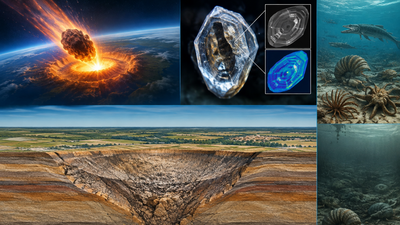
A meteor impact buried beneath the small town of Ames, Oklahoma, has been given a dramatically different age. For years, the Ames impact structure was linked to a major meteor bombardment around 467 million years ago during the Ordovician Period. But new research from the University of Texas at Austin has dated zircon crystals from impact-melt rock to about 370 million years ago, shifting the event forward by nearly 100 million years. The study, published in Meteoritics & Planetary Science, suggests the impact may date to the Late Devonian, close to the timing of a major marine extinction event.
A crater hidden beneath Oklahoma
The Ames impact structure is not a crater visible at the surface today. It lies beneath layers of sedimentary rock near Ames, Oklahoma, and stretches several miles underground. The structure is also significant for Oklahoma’s oil and gas industry, as the area has been an important producer. For decades, scientists placed the impact at roughly 467 million years ago. That estimate came largely from fossils found in material filling the crater. In particular, researchers identified teeth belonging to conodonts, an ancient eel-like group of animals that lived during the Ordovician.Because the fossils were associated with rocks from that period, the Ames impact became part of what scientists call the Ordovician Meteor Event, a period when several large impacts appear to have occurred across North America. The concentration of impacts around that time has even led to the idea that a large asteroid may have broken apart and produced a cloud or ring of debris around Earth, somewhat resembling Saturn’s rings. The newly revised age of Ames, however, removes one major impact structure from that picture.
Zircon crystals tell a different story
The new study, led by Elizabeth Catlos of the University of Texas at Austin, used a different approach to determine when the impact occurred. Researchers examined tiny zircon crystals from impact-melt rock containing fragments of older granodiorite. Zircon is particularly useful for geologic dating because it can preserve information about when geological events occurred. The team used uranium-lead dating on 37 analytical spots through two techniques, secondary ion mass spectrometry and laser-ablation inductively coupled plasma mass spectrometry. Most of the zircon dates reflected the much older granodiorite that existed before the impact. But a group of the youngest measurements produced a remarkably consistent age of 369.7 million years, with an uncertainty of about 5.9 million years. That result is dramatically different from the previously accepted Ordovician age.The researchers also examined the crystals using cathodoluminescence and electron backscatter diffraction to look for microscopic evidence of impact-related changes. Two zircon grains showed textures consistent with impact-related processes, providing additional evidence that the samples recorded effects associated with the impact.
Why the old fossil evidence may have been misleading
The difference between the two ages does not necessarily mean the fossils were incorrectly identified. Instead, the problem may be what those fossils were actually dating. The conodont teeth found at Ames could have already been millions of years old when the meteor struck. A powerful impact can excavate and mix older material into newly formed deposits. In that scenario, the fossils would tell scientists about the age of the rocks that were hit, rather than the date when the meteorite arrived.The new zircon results therefore provide a stronger constraint on the timing of the impact itself. The study notes that relying on a small amount of fossil material can be challenging when attempting to establish the precise age of an impact structure.
The impact may belong near a major extinction
Perhaps the most significant consequence of the new date is where it places the Ames impact in Earth’s history. An age of about 370 million years puts the impact in the Late Devonian, close to the Frasnian-Famennian boundary, associated with a major extinction around 372 million years ago. The event severely affected marine life and is one of the significant extinction episodes in the geological record. This timing does not prove that the Ames meteorite caused the extinction. Instead, it raises a question about whether the impact could have been part of a broader period of environmental disruption.Scientists have long debated the relative roles of events such as asteroid impacts, volcanic activity and other changes within Earth in driving major extinctions. A more accurate chronology can help researchers determine whether different events actually happened close enough together to have been connected.
Ames changes the map of ancient impacts
The revised age also changes how scientists understand the distribution of ancient meteor impacts across North America. If the 370-million-year date is correct, Ames should no longer be grouped with the cluster of impacts associated with the Ordovician Meteor Event. Instead, it may belong to a much younger group of Late Devonian impacts that occurred around the time of the Frasnian-Famennian extinction.The researchers acknowledge that more material would be valuable for confirming the interpretation. The amount of rock available from the Ames cores is limited, making it difficult to recover large numbers of suitable zircon grains. Still, the new evidence represents a major shift in the crater’s history. A structure once considered part of a 467-million-year-old meteor bombardment may instead record an impact around 370 million years ago, placing Oklahoma’s buried crater much closer in time to one of Earth’s major ancient extinction episodes.