


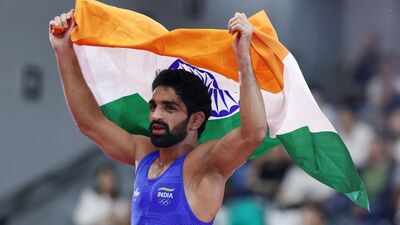
NEW DELHI: For months, Aman Sehrawat had carried a picture of the Asian Games gold medal on his phone. It was more than a wallpaper; it was a daily reminder of the colour he wanted after returning from Hangzhou with bronze. On Saturday, after beating North Korea’s reigning world champion Han Chong Song 11-7 in the 57kg final, Sehrawat looked at the real medal, bit it, and allowed himself a moment of disbelief. The picture had become reality.The road to it had not been smooth. A cut beneath his left eye left him bruised during the bout, but not distracted. Han surged back from 1-6 to lead 7-6, yet Sehrawat answered with two takedowns, regained control and closed out the comeback. Earlier, he had beaten Japan’s Yamato Ogawa 20-9, Kazakhstan’s Nurdanat Aitanov 12-1 and Tajikistan’s Aiaal Belolyubskii 14-8.The gold also carries a difficult lesson. Last year, Sehrawat was eliminated from the World Championships after weighing 1.7kg over the 57kg limit, which led to a one-year suspension from the Wrestling Federation of India (WFI). The ban was later lifted after he apologised. He competed at 61kg in the Zagreb Open and Asian Championships, taking silver at both, before returning to 57kg and winning the Budapest Ranking Series event ahead of the Games.Weight had become a difficult proportion to manage, but that discipline made Saturday sweeter. Sehrawat, now 23, is already a U-23 world champion, a Paris Olympic bronze medallist and a Hangzhou bronze medallist. Now he has added the continental crown and upgraded his Asian Games colour from bronze to gold.Sehrawat’s wrestling journey began in far darker circumstances. He lost his mother at 10 and his father a year later, leaving him orphaned at 11. His maternal uncles stepped in, brought him to Delhi’s Chhatrasal Stadium and set him on a path from grief to purpose. Under coach Lalit Kumar, the boy from Haryana became a solid wrestler with a force to reckon with.India’s remarkable wrestling campaign at the ongoing edition became even sweeter, and historic as well, after Antim Panghal’s silver in women’s 53kg and Deepak Punia’s bronze in men’s 97kg took the nation’s tally to six wrestling medals — two gold, two silver and two bronze. It was the country’s best Asian Games haul in 64 years. The last time India collected more was Jakarta in 1962, with 12 medals.Antim, a Hangzhou bronze medallist, reached the final of her weight division hoping to become only the second Indian woman after Vinesh Phogat to win Asian Games wrestling gold. Japan’s Moe Kiyooka, however, proved too sharp, controlling the contest and winning 9-1. Antim’s silver still underlined a strong campaign, though gold remained beyond reach.Punia added bronze after edging Mongolia’s Gankhuyag Ganbaatar 2-1 in the medal-deciding repechage bout. He had beaten China’s Zhou Junpeng 12-2 before a quarterfinal walkover, then lost an 8-9 semifinal to Uzbekistan’s Sherzod Poyonov. He recovered to finish on the podium.For Indian wrestling, Nagoya ended with an impressive haul. For Sehrawat, it ended with something more personal: a wallpaper, a promise and, finally, the gold he had spent months imagining.