


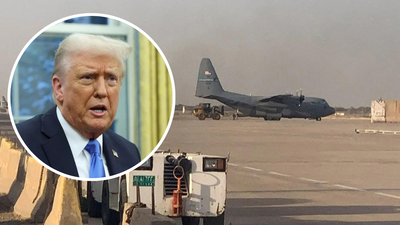
US President Donald Trump on Wednesday hailed the withdrawal of American troops from Iraq as an “orderly” end to a 12-year mission against the Islamic State group, as the last US forces left an air base in northern Iraq under a deal between Washington and Baghdad.Trump described the withdrawal, completed by the September 30 deadline, as the end of what he called “a very expensive excursion into Hell”. At a White House event, he said the US involvement in Iraq had resulted from “very bad decision making” and called the conflict a “quagmire” that had lasted for many years.“It’s been a long time with very bad decision making that got us involved in this quagmire in the first place. It was a quagmire. For many, many years it lasted. But soon that part of history will be over,” Trump said.He said the withdrawal represented a victory for the US and Iraq and marked a victory over the Islamic State group.
US shifts to Iraqi-led security
Pentagon spokesperson Sean Parnell said US troops and equipment had completed an “orderly departure” from the air base in Irbil in Iraq’s semi-autonomous Kurdish region.“This milestone reflects the success of a 12-year campaign that defeated ISIS as an organised military threat in Iraq and across the region,” Parnell said. “It also marks a transition from a wartime coalition mission to an Iraqi-led security effort supported by a more normal bilateral security relationship.”He said the US military would continue to provide “targeted training and intelligence support” to Iraqi partners.Iraqi Prime Minister Ali al-Zaidi presided over the handover ceremony and described the withdrawal as the start of a “new phase” centred on Iraq’s sovereignty and stronger institutions.He said Iraqi security forces would continue fighting Islamic State and that the government would ensure non-state groups no longer held weapons.
Withdrawal comes amid Iran war
The US exit comes as Washington remains engaged in a war with Iran that has also spilled into Iraq.Iran-backed Iraqi militias have attacked US positions, while the US has carried out strikes against militia strongholds. Bases in the Kurdish region have faced repeated attacks since the US and Israel launched their war against Iran on February 28.Trump also compared the Iraq conflict with his administration’s military actions in Iran, arguing that the Iran war and a one-day US operation in Venezuela earlier this year had taken less time and resulted in fewer US military deaths.The withdrawal also reflects Washington’s broader effort in recent years to shift its strategic focus from the Middle East towards Asia. That shift has been complicated by renewed US military involvement in the region.
US presence in Iraq dates back to 2003
The US invaded Iraq in 2003 to overthrow Saddam Hussein and withdrew its forces in 2011.Three years later, Baghdad invited a smaller US-led mission to help fight Islamic State after the group seized large areas of Iraq. As the group was reduced to scattered sleeper cells, Washington and Baghdad agreed in 2024 to wind down the mission.Most US troops left Iraqi bases last year, leaving several hundred in the semi-autonomous Kurdish region until Wednesday’s final withdrawal.The departure was welcomed by Iran-backed groups but has also raised concerns in parts of Iraq, particularly the Kurdish region, over the possibility of renewed Islamic State attacks and further strikes by Iran-linked groups.
Questions remain over Iraqi militias
The future of Iraq’s powerful armed groups remains uncertain. Baghdad had initially linked the September 30 US withdrawal deadline to the disarmament of non-state militias.Some smaller groups agreed to hand over their weapons, but powerful Iran-aligned militias rejected the move or imposed conditions. Al-Zaidi has since pushed the disarmament deadline to June 2027, according to an interview with The New York Times earlier this month.The Kurdish regional government’s Peshmerga Ministry said the region had faced more than 1,000 drone and ballistic-missile attacks during the recent US-Iran conflict. It expressed concern over the departure of US forces and the removal of American air defence systems.Iran-backed groups, meanwhile, celebrated the US withdrawal.Kataib Hezbollah security official Abu Mujahid al-Assaf called the departure “the beginning of full sovereignty” but warned the Iraqi government against carrying out what he described as American plans.The Islamic Resistance in Iraq, an umbrella group of Iran-backed militias, said it was “not bound by any timeline or agreement” announced by the government or political groups, while saying it remained open to dialogue over weapons and Iraq’s sovereignty.