


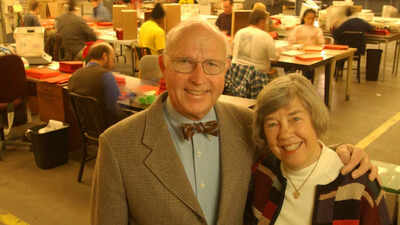
Charles P. Baker III, who started a small business in his garage in 1980 to create a job for his son, went on to build an organisation that helped more than 12,500 people find work. Baker, who co-founded Baker Industries with his wife Louise, died on September 16 at the age of 101, The Philadelphia Inquirer reported.Baker Industries began with Baker, his wife and their son Justin. Justin lives with epilepsy and had struggled to find suitable employment. The family started a two-person mail-order packaging firm in their Strafford garage, with Justin becoming their first employee.The business later developed into Baker Industries, a workforce development nonprofit based in Malvern. Over nearly five decades, it hired, trained and mentored people who often faced difficulties finding jobs elsewhere, including people with physical and intellectual disabilities, substance use disorders, recent periods of incarceration and housing insecurity.The idea behind the organisation came from the Bakers’ own experience. “We decided, if we’re going to start something like this, let’s go for the people who need it the most,” Baker told The Inquirer in 1998, “the ones who are least employable.”
From a garage to a workforce programme
Baker Industries went on to contract light industrial and office work for hundreds of businesses. It operated facilities in Philadelphia, Malvern and other locations, while its employees were paid an hourly wage and given additional training.The organisation also encouraged workers to attend workshops, social events and support group meetings. Its motto was “providing a steppingstone to regular employment”, with many workers eventually moving to higher-paying jobs elsewhere.Baker described the approach as more than simply giving people jobs. “We have a philosophy of work as rehabilitation,” he told the Daily News in 1988. “The goal is to show these people they can do a whale of a lot more than they think they can do.”Baker remained involved with the organisation for decades. He served as its unpaid president until 2002 and then continued on its board of directors. Colleagues later remembered the work he and Louise had built around the idea that employment could play an important role in helping people move forward.“Charlie and Weezie Baker believed there is healing in work,” colleagues at Baker Industries said in a Facebook tribute on his 101st birthday in June. “Not just jobs. Work. Showing up. Being part of something. Contributing alongside others.”

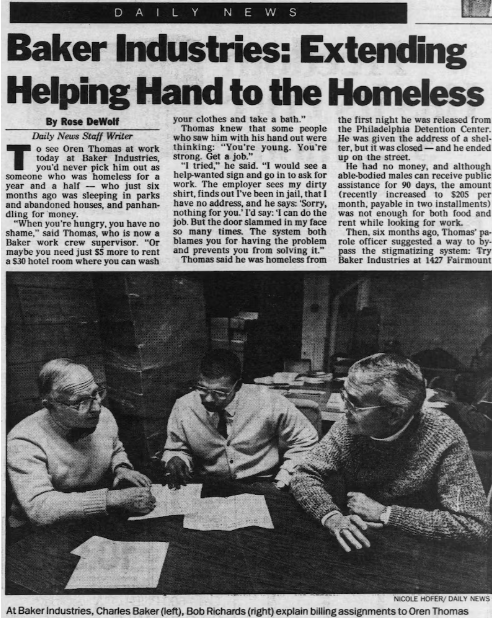
Article on Mr. Baker appeared in the Daily News in 1990.
A different approach to hiring
Baker Industries also took a different approach to people with criminal records or histories of drug use. Baker explained this in a Daily News interview in 1990.“We don’t screen out people who have a criminal record or who have used drugs because we know that’s a big part of why people become homeless.”He also called on other employers to focus on a person’s present circumstances rather than only their past. “We need employers who will look at what these people are doing now instead of what they have done before,” he told the Daily News in 1998.The organisation and the Bakers received recognition for their community work. In 1991, Baker Industries was named an inspirational Point of Light by President George H.W. Bush. In 2004, Baker and his wife received the legacy award for “community generosity” from the Chester County Community Foundation.A foundation official told The Inquirer at the time that the couple “went above and beyond their own self-interest.”Nic Watson, president of Baker Industries, said Baker’s example would continue to guide the organisation. “I was grateful to have their guidance,” Watson said, “and we will follow their example for years to come.”
Baker’s life beyond the organisation
Baker’s career before Baker Industries included running his family’s chemical company. In the 1950s, he took control of C.P. Baker & Co., expanded the business and sold it in 1980.He had also served in the US Army after graduating from the US Military Academy in 1946. He spent more than seven years in the Army, was stationed in Europe and rose to the rank of captain.Away from work, Baker remained active for much of his life. He was a squash player, skier and sailor. He won the US national hardball singles squash championship six times in the 80-and-older division between 2006 and 2016. He skied into his 70s, sailed into his 80s and continued playing squash and tennis at the Merion Cricket Club until recently.Baker was born in Philadelphia on June 24, 1925. He grew up at the old Colonial Hotel at 11th and Spruce Streets in Washington Square West. His father, Charles Jr., was the hotel’s manager. Baker’s mother died when he was 11.He met Louise Wilhelm while water-skiing in Ocean City. They married in 1955 and had two sons, Charles IV and Justin, and a daughter, Sandra. Louise died in 2025.His family said he was a “relentlessly joyful spirit”. His daughter described him as a funny father who liked singing show tunes and writing corny poems on birthday cards. “He was a wonderful dad who loved his family,” she said.Baker died of congestive heart failure at HarborChase assisted living community in Wilmington. He is survived by his children, four grandchildren, five great-grandchildren and other relatives.