


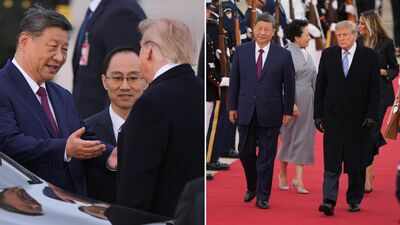
Chinese President Xi Jinping arrived in Washington on Wednesday for a three-day state visit, receiving a rare airport welcome from US President Donald Trump as the two leaders prepare for talks on trade, technology, artificial intelligence, military ties, Iran, Taiwan, the Russia-Ukraine war and other geopolitical issues.Xi and Chinese First Lady Peng Liyuan arrived at Joint Base Andrews in Maryland, where Trump and First Lady Melania Trump were waiting to receive them. The visit marks Xi’s first trip to Washington since 2015 and the second summit meeting between Xi and Trump in less than six months.The high-profile visit combines elaborate ceremonial events with closed-door discussions on issues that have kept Washington and Beijing at odds. The programme includes a White House arrival ceremony, troop review, a black-tie state dinner and a visit to the National Archives.
Rare airport welcome for Xi
Trump personally travelled to Joint Base Andrews to receive Xi, rather than waiting for the Chinese president to arrive at the White House.The aircraft carrying Xi and Peng touched down at 5.39 pm local time on Wednesday. Trump and Melania were waiting at the foot of the aircraft ladder when Xi and Peng disembarked at 6.01 pm local time.The welcome featured a 21-person honour cordon, a 100-foot red carpet, the US Air Force Band and ceremonial cannon fire. Two US Air Force B-1 bombers also flew over the airbase as the national anthems of the United States and China were played.After a brief welcome exchange, Xi and Peng walked down the red carpet before leaving the airbase in a motorcade. Trump and Melania returned to the White House aboard Marine One.According to the material provided, it was the first time since 1962 that a US president had welcomed a foreign leader at an airport. Then-president John F Kennedy had welcomed British prime minister Harold Macmillan at the airport that year.
Why Trump is giving Xi such a high-profile welcome
The elaborate reception is intended to reciprocate the ceremonial grandeur surrounding Trump’s visit to China in May.Xi was not at the airport when Trump arrived in Beijing. Chinese Vice President Han Zheng received Trump instead. However, Air Force One was welcomed with a red carpet, military honour guard, military band and about 300 Chinese youths carrying Chinese and American flags and chanting, “Welcome, welcome! Warm welcome!”Trump has also made clear that he wants to give Xi an elaborate reception in Washington.Melania Trump said her husband decided to personally greet Xi because “they have a great relationship.”“He’s coming on our soil, and we need to welcome them with the most respect,” she said during an interview with Fox News Channel’s “Fox & Friends.”
Trade and tariffs
Trade tariffs are expected to be among the key issues during the Trump-Xi discussions.The visit comes against the backdrop of continuing disagreements between the world’s two largest economies. A US-China trade agreement reached last year is also set to expire in November, adding another issue to the discussions.The two leaders are expected to discuss the broader economic relationship as they seek to maintain what has been described as “strategic stability” between Washington and Beijing.
Artificial intelligence and technology
Technology and artificial intelligence are also expected to feature prominently in the talks.The visit comes as the US and China compete over advanced technologies and AI capabilities. Technology executives are also expected to be present at the White House state dinner.The dinner will feature tech industry leaders including Nvidia’s Jensen Huang and SpaceX’s Elon Musk.Trump’s previous China visit also included prominent US technology executives, including Apple’s Tim Cook, Musk and Huang.
Military ties and China’s military buildup
Military relations and China’s expanding military capabilities are expected to be another subject of discussion.Sen. Roger Wicker, chairman of the Senate Armed Services Committee, criticised what he described as the “lavish welcome” being extended to Xi.Wicker said Trump should not have invited the Chinese leader “based on all of the troubling issues we have with President Xi and the Chinese Communist Party.”Wicker suggested that Trump should discuss “the purposes of China’s massive military buildup, or about China’s clear support for Iran” during the state dinner.He said that “during every minute of dialogue” Trump should keep in mind that “his guest is a brutal, unelected and oppressive dictator who seeks to dominate his neighbors and whose massive military arsenal is aimed directly at the United States of America.”
Taiwan and US arms sales
China’s designs on Taiwan and US arms sales to Taiwan are also expected to feature in the discussions.Taiwan remains one of the major points of disagreement between Washington and Beijing. The US-China talks are therefore expected to cover military issues connected with the island, including US arms sales to Taiwan.The issue comes alongside broader discussions on military ties and China’s military buildup.
Iran and Middle East conflicts
The war in Iran and conflicts in the Middle East are also expected to figure in the talks.Wicker urged Trump to raise what he described as China’s “clear support for Iran” during discussions with Xi.The two leaders are expected to discuss the broader regional security situation as part of their talks, alongside other geopolitical issues.
Russia-Ukraine war
The Russia-Ukraine war is another international issue expected to be discussed by Trump and Xi.The war has become part of the wider strategic relationship between Washington and Beijing, with the two countries taking different positions on the conflict.The issue is expected to be discussed alongside the Middle East, Taiwan and military relations.
Arms race in space
The two leaders are also expected to discuss the arms race in space.The issue forms part of a broader agenda covering military ties, advanced technology and strategic competition between the United States and China.
Human rights and detained Americans
Trump is expected to raise the cases of US citizens detained in China, although it remains unclear how extensively broader human-rights issues will feature in the talks.A US official said Trump was likely to bring up cases of people wrongfully detained in China with Xi.Trump is expected to ask Xi to free Youlin Chen, a Chinese-born expert on North Korean nuclear tests who has been imprisoned since late 2024, and Min Zin, a scholar arrested in June. Both are US citizens.Trump had raised Chen’s case during his meeting with Xi in Beijing in May, but according to Chen’s wife, Yufang Rong, there has been no change since then.“We hope to see Dr. Chen and Zin come home after this meeting,” said Elizabeth Richards, research director of the James Foley Foundation, a hostage advocacy group.Broader human-rights issues involving Tibet, the Uyghur Muslim minority and Hong Kong may also come up, although the White House has not said whether Trump will directly raise them.
China warns human rights are a ‘red line’
Beijing has indicated that human rights and democracy are sensitive issues in the bilateral relationship.China’s ambassador to the US warned on Wednesday that democracy and human rights are “red lines” that cannot be crossed.Human rights groups and Democratic lawmakers have called on Trump to raise China’s treatment of Tibetans and Uyghurs and speak up for Hong Kong pro-democracy protesters.“We cannot abandon human rights in our foreign policy,” Democratic Representative Jim McGovern of Massachusetts said. “China’s record is beyond debate and it is atrocious.”Human rights groups say China has detained Uyghurs on the pretext of countering extremism and confined them in re-education camps. US secretaries of state from both parties have labelled the treatment of Uyghurs as genocide.“Xi’s visit to Washington is a strategic moment to move beyond words of condemnation on the Uyghur genocide,” World Uyghur Congress President Turgunjan Alawdun said.Beijing says it has established “vocational training centers” to curb extremism and denies abuse allegations.
Tibet issue and Dalai Lama dialogue
Tibet is another issue that could add to the human-rights discussion.Rights groups and exiles have described China’s rule in Tibet as “oppressive”, an accusation Beijing rejects. China has exerted greater control over the region since Xi became chief of the Communist Party in 2012.Beijing has said Washington should stop using “Tibet-related issues to interfere in China’s internal affairs.”The International Campaign for Tibet called on Trump to ask Xi “to resume substantive dialogue without preconditions” with the Dalai Lama, the spiritual head of Tibetan Buddhists and a Nobel Peace Prize laureate.
China’s ethnic unity law
China’s new law concerning ethnic unity is also part of the broader human-rights debate surrounding the visit.China passed a law this year to create a shared national identity among the country’s 55 ethnic minority groups. The legislation includes penalties for people outside the country for “inciting ethnic separatism.”The US State Department has described the law as problematic.Katie LaRoque, director for policy and advocacy at Freedom House, urged Trump to condemn the legislation himself.“President Trump must make clear that Beijing’s domestic law has no jurisdiction over those exercising their fundamental freedoms on US soil,” she said.
Marco Rubio defends high-level engagement
US Secretary of State Marco Rubio said Washington and Beijing must continue to engage at the highest levels despite their disagreements.Rubio described the US and China as “the two largest economies in the world” and “probably the two most powerful militaries in the world.”“The idea that we would not interact with them at the highest levels is irresponsible. It’s outrageous. We have to,” Rubio told reporters Wednesday while he was in New York.He later said: “The relationship between the United States and China will define the 21st century.”Rubio also acknowledged strong disagreements between the two countries and said continued engagement was necessary.“I think it’s an obligation to be able to interact at the highest levels now. I think that’s what this visit reflects, is the president’s belief that no matter what our disagreements and differences may be with the Chinese government, this is not some small country,” Rubio said.
Thursday: White House ceremony and state dinner
Xi’s airport welcome will be followed by a more formal programme at the White House on Thursday.Xi will be accorded a ceremonial welcome and a review of troops before the two leaders move into closed-door discussions.The day will culminate in a black-tie state dinner at the White House.The dinner is expected to include leading technology executives such as Nvidia’s Jensen Huang and SpaceX’s Elon Musk.The visit is expected to combine diplomatic discussions with extensive ceremonial events, even as expectations remain low that it will produce any major breakthroughs in the US-China relationship.
Friday: Private tea and National Archives visit
The final day of Xi’s visit will focus on a more private and cultural programme.On Friday, Xi and Peng will return to the White House for a private tea with Trump and Melania.The two couples will then visit the National Archives in Washington.The White House has said they will view historic documents underscoring the relationship between the United States and China.Melania has also planned a visit to the Smithsonian National Museum of Asian Art with Peng Liyuan to showcase cultural connections between the two countries.
Who is travelling with Xi?
Xi is travelling with Peng Liyuan and senior Chinese officials including Cai Qi, a member of the Standing Committee of the Political Bureau of the Communist Party of China Central Committee and director of the General Office of the Central Committee, and Foreign Minister Wang Yi, a member of the Political Bureau of the Central Committee.The exact names of Chinese business executives accompanying Xi were not confirmed in the material provided.Xi and Peng are scheduled to return to China on Friday.
Xi’s first Washington visit since 2015
The visit is Xi’s first trip to Washington since 2015, when he was received by then-President Barack Obama.It is also the second summit meeting between Xi and Trump in less than six months, following Trump’s visit to China in May.The three-day visit brings together an extensive agenda covering trade, tariffs, technology, AI, military ties, Taiwan, Iran, the Russia-Ukraine war, space security and human rights.While Trump has sought to project warmth towards Xi through an unusually elaborate welcome, the talks will take place against a backdrop of major strategic and economic disagreements between Washington and Beijing.