


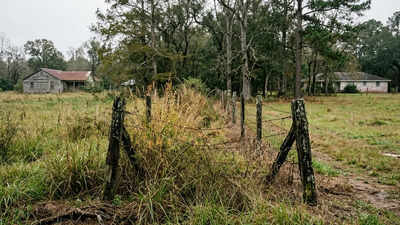
A property boundary dispute between two neighbouring families in Louisiana went from arguments over a 70-foot strip of land to large “No trespassing” signs, bright lights, loud generators and a dead cow placed near the disputed boundary. The Louisiana Court of Appeal, Second Circuit, has now upheld a lower court ruling that fixed the boundary at an old downed fence and ordered one family to pay $15,000 in damages.Jesse Justin Colvin and Ruby Sue Hill Colvin bought a 23-acre property in Union Parish in 2012 and made it their home. Robert Bradford Jones and Roni Michelle Reppond Jones bought a one-acre property nearby in 2014 and also lived there. According to Find Law, the court record says the families were friends and good neighbours for more than a decade before the property line became disputed.The disagreement centred on a strip of timber and undergrowth about 70 feet deep between the properties. The Colvins argued that the strip was entirely within their property and pointed to 1989 and 2012 surveys. The Joneses, however, said the boundary was an old combination or wire fence located further south. The fence was down, but remnants of it remained.As the disagreement continued, the Colvins put “No trespassing” signs along the surveyed property line. When the Joneses continued to claim the disputed area, the Colvins put up larger signs. The dispute eventually reached court in September 2023, when the Colvins filed a lawsuit seeking to have the boundary formally fixed.
Court fixes boundary
The case involved several surveys and testimony about the old fence. A 2012 survey by professional land surveyor James Michael Duty showed the “old wire fence (down)” south of the northern boundary of the Colvin property. Duty testified that the fence shown in his survey was in the same location as the downed combination fence identified in an earlier survey.Duty said the recorded property line was north of the old fence and that the 2012 survey matched the public records. Jesse Colvin also acknowledged that the 2012 survey referred to the old fence line.However, Jesse testified that he had the property surveyed again in 2022 because he did not know where the property line was. He said steel posts placed by his grandchildren were positioned according to that survey. He also acknowledged that before the dispute, he had never visited the northern boundary in question and had never kept livestock or cut trees there.The Joneses gave a different account of their use of the area. Robert Jones said he believed the old fence marked the boundary when he bought the property and that he had used the disputed area for hunting. He admitted that he had not conducted a survey and did not know the exact property lines on the eastern and western sides of his property.The trial court considered the surveys, witness testimony and evidence before deciding that the title records could not settle the disputed boundary. It found that the old downed fence represented the limits established by possession and fixed the boundary there.The Colvins challenged that decision before the appeals court. They argued that the boundary should instead be decided according to their title and the surveys. The appeals court rejected the argument and said the trial court had not made a clear error in fixing the boundary at the old fence.
Signs, lights and dead cow
The boundary argument was not the only issue before the court. The Joneses also sought damages and a permanent injunction, saying the Colvins interfered with their use of their property.According to the court record, Jesse Colvin installed orange construction fencing near the boundary and, on April 11, 2023, put a series of 8-by-12-foot commercial signs along the Joneses’ property line. The signs said “Private property, no trespass”.On May 4, 2023, Jesse moved one of his dead cows into the wooded area near the Joneses. He said he had placed it there temporarily until he found a place to bury it. But the court noted that he did not deny telling Robert Jones during a recorded call, “I was fucking with you with the dead cow.”Later, on May 20, Jesse erected three larger signs, each measuring four feet by 16 feet and mounted on eight-foot poles. They were placed about 10 feet from the northern boundary and faced the Jones property.Two fluorescent orange signs carried the words “No trespassing from neighbours” along with poop-emoji symbols. The third said “J-one hog farm coming soon”. Jesse said the signs were prompted by a letter from Robert Jones. The trial court, however, found that the letter had simply asked the families to end their dispute.Three days later, on May 23, Jesse installed lights to illuminate the signs. The lights were powered by a generator. Robert Jones testified that the generator was loud enough to make his whole house vibrate. Jesse admitted that he illuminated the signs specifically to send Robert a message to leave him alone.
Court upholds injunction and $15,000 damages
The Joneses argued that the signs, dead cow, fencing, bright lights and generator noise substantially interfered with their enjoyment of their home. The trial court agreed and found that Jesse’s actions were intentional, served no legitimate purpose and caused the Joneses fear, anxiety and loss of enjoyment of their backyard.The court ordered the Colvins to remove the signs, posts, lights and other flagging materials and prohibited similar materials from being placed at the disputed location.The Colvins argued on appeal that the Joneses had suffered only inconvenience and had not shown physical property damage, medical evidence of distress or financial loss. The appeals court did not accept that argument.The court referred to Louisiana law, under which a landowner cannot carry out work on their property that deprives a neighbour of the ability to enjoy their own property or causes damage. It also noted that an injunction can be granted when there is substantial interference with the peaceful use of property and the problem is likely to continue without court intervention.The appeals court said the evidence supported the lower court’s finding that the conduct created real damage and irreparable injury. It also upheld the damages awarded to Robert and Roni Jones.The lower court had ordered Jesse Colvin to pay $7,500 to each of the Joneses, bringing the total damages to $15,000.The Louisiana Court of Appeal, Second Circuit, decided the case on January 14, 2026. It affirmed the lower court’s ruling in full, including the boundary fixed at the old downed fence, the permanent injunction and the $15,000 damages award. The Colvins were also ordered to pay the costs of the appeal.