


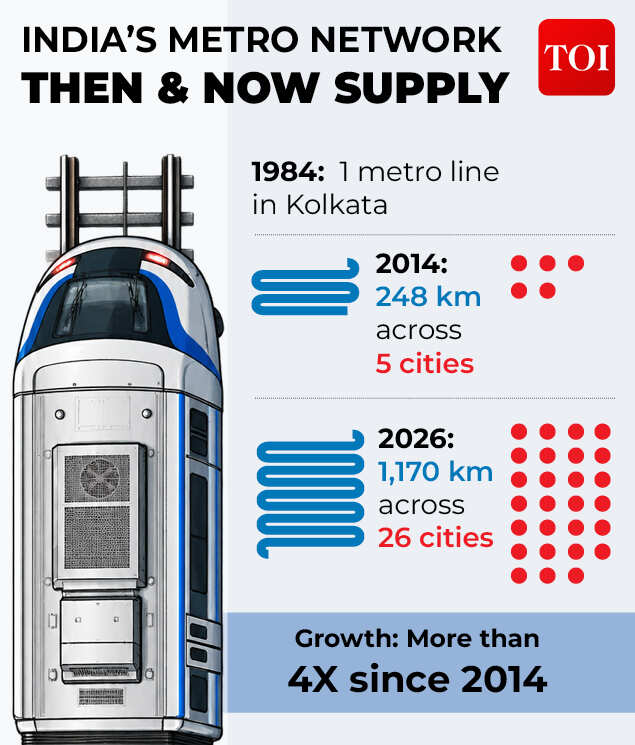
In 1984, India had exactly one metro line, in Kolkata. Today, the network spans 26 cities and is just 216 km short of surpassing the US to become the world’s second-longest metro network.From one line to a national network, India’s metro story has travelled a long way, and much of that journey has happened in little more than a decade.The latest milestone came in Indore. After inaugurating an extended metro service on September 5, Union housing and urban affairs minister Manohar Lal Khattar said India’s operational metro network had reached 1,170 km across 26 cities, compared with 1,386 km in the US.“I think in the next two years, we will overtake the US and become the world’s second-largest country in terms of metro rail network after China,” he said.China, at around 8,000 km, remains far ahead.The numbers are striking, but the real story is how India went from having metro rail in just a handful of cities to building one of the world’s largest networks in little more than a decade.
Kolkata: Where it all began
India’s metro journey began with Kolkata’s first stretch in 1984. For years, metro rail remained concentrated in a small number of cities. Even by 2002, India had only around 25 km of metro across Kolkata and the newly opened Delhi Metro.By 2014, the operational network had reached around 248 km across five cities. Since then, the expansion has accelerated sharply. By 2025, the network had crossed 1,000 km and expanded to 26 cities.

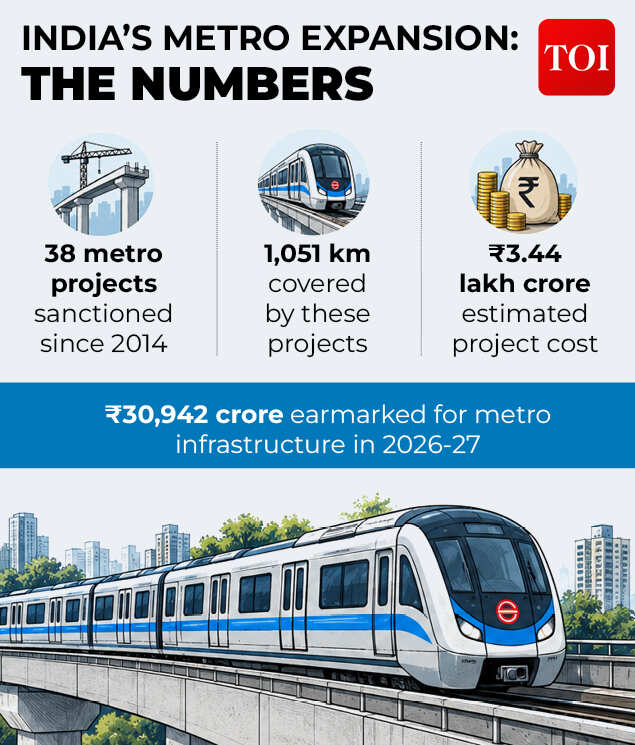
Government data put the operational network at 1,095 km in 2025 and more than 1,155 km in 2026, before the latest Indore expansion took the figure cited by Khattar to 1,170 km.A status report by the ministry of housing and urban affairs in July this year put India’s operational metro and regional rapid transit network at roughly 1,159 km.The pace of construction changed just as dramatically. The government says the average rate at which metro lines were commissioned rose from about 0.68 km a month before 2014 to nearly 6 km a month in the subsequent period.The expansion was followed by increased funds.Since 2014, 38 metro projects covering 1,051 km have been sanctioned at an estimated cost of around Rs 3.44 lakh crore. Annual central government allocation for metro infrastructure rose from Rs 5,798 crore in 2013-14 to Rs 29,550 crore in 2025-26, with about Rs 30,942 crore earmarked for 2026-27.
The map has also moved beyond traditional megacities. Lucknow, Jaipur, Kochi, Ahmedabad, Nagpur, Pune, Kanpur, Agra, Bhopal, Indore and several other cities have joined the metro map. Bhopal became the 26th Indian city with an operational metro network in December 2025.
Delhi’s experiment becomes a national network
If Kolkata started India’s metro story, Delhi helped turn it into a model for large-scale urban transport.Delhi and the National Capital Region now form India’s largest metro cluster. Delhi Metro is roughly 374 km long, with 271 stations and 10 lines.Bengaluru’s Namma Metro has about 96 km operational, with another 80 km under construction. Kolkata, where the story began, now has five lines.Maharashtra has emerged as another major metro hub, with systems and projects spread across Mumbai, Pune and Nagpur. Uttar Pradesh has Lucknow, Kanpur and Noida, alongside the Delhi-Meerut Namo Bharat corridor.Other major systems are spread across Karnataka, Telangana, Gujarat and Tamil Nadu.But the national number hides an important reality: India’s metro kilometres are still concentrated in a few major urban clusters, and passenger traffic is even more concentrated.
The next metro boom already under construction
India’s next phase of expansion is not merely sitting on a drawing board. A substantial part of it is already being built.Recently, MoHUA told Parliament that around 886 km was under implementation across 30 projects. The numbers differ with the date and classification, but both point to a substantial construction pipeline.Major projects include Delhi Metro Phase IV, Chennai Metro Phase II covering 116 km, Bengaluru’s Phase II, 2A, 2B and Phase III corridors, several Mumbai lines, Pune Metro’s Line 3 to Hinjawadi, Kochi Metro Phase II, Gurugram Metro and a first full network for Surat of just over 40 km.
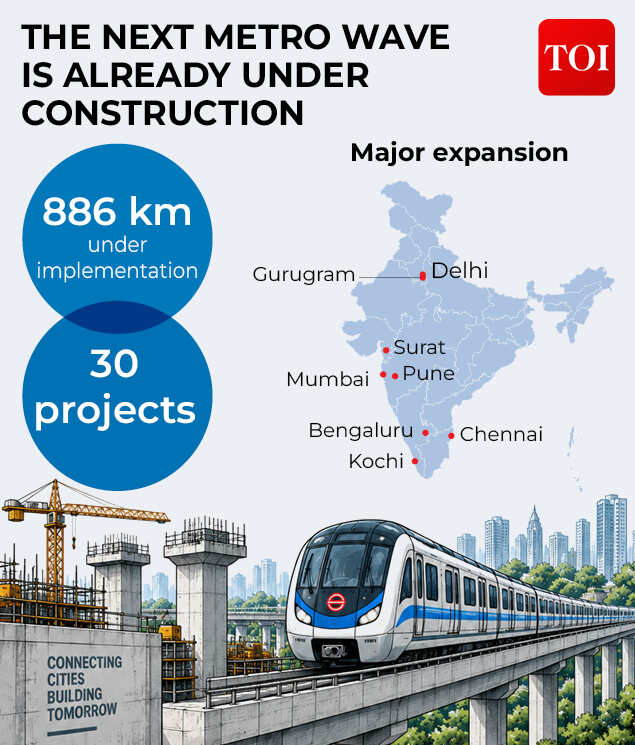
Tier-II cities are part of the next wave too.Bhopal and Indore are expanding their networks, while Agra, Patna and Kanpur are building out their systems.The Indore extension itself offers a snapshot of this expansion. The city had been operating commercial services on a six-km stretch. The latest extension, built at a cost of Rs 2,850 crore, takes the network to 17 km and 16 stations, with trains every 15 minutes and more than 80 trips a day.Madhya Pradesh chief minister Mohan Yadav has said the network will eventually reach Ujjain and nearby areas.The exact size of India’s network by 2030 will depend on how quickly these projects are completed, as well as on new approvals. Project schedules can also change because of land acquisition, construction, financing and other implementation challenges.So India is not closing the gap with the US using only the network it has today. Hundreds of kilometres are being built simultaneously.
India vs US: What does the 216-km gap really mean?
Khattar’s September 5 comparison puts India’s metro network at 1,170 km and the US network at 1,386 km, leaving a gap of 216 km. But international metro comparisons are not perfectly straightforward because countries classify urban rail systems differently.In the US, the 1,386-km figure cited by Khattar refers to heavy-rail metro systems, including those in New York, Washington, Chicago and Boston. The US also has large light-rail and commuter-rail networks, which are classified separately.
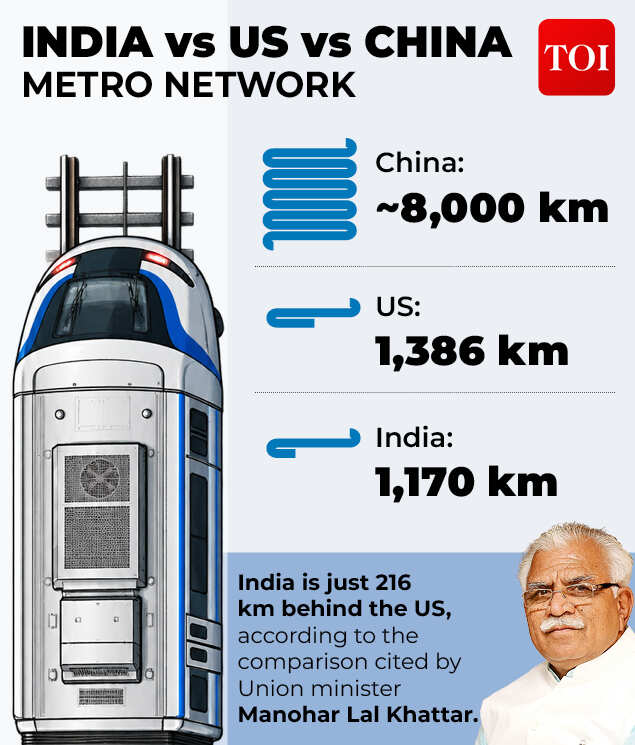
The International Association of Public Transport, or UITP, maintains its own global metro database covering 247 networks in 202 cities, using a defined methodology for urban rail systems operating on an exclusive right-of-way.So the 1,170-km Indian figure and the US figure should be understood as the basis of the minister’s comparison rather than as a perfectly standardised global measurement.The broader trend, however, is clear.Now, India stands among the world’s major metro markets and continues to expand rapidly, while China remains far ahead at around 8,000 km.
More than just metro
India’s urban rail story is also moving beyond conventional metro systems.The Delhi-Meerut corridor brought Namo Bharat regional rapid transit into the picture. Designed to connect major urban centres with surrounding cities and towns, it can operate at higher speeds than conventional metro systems.It began operations in October 2023 at speeds of up to 160 kmph, with 55 km of the 82-km corridor operational by late 2025.Other innovations have expanded the definition of urban rail.Kolkata opened the country’s first underwater metro tunnel in 2024. Kochi became the first Indian city to operate a Water Metro in April 2023, using electric-hybrid boats to connect 10 islands.
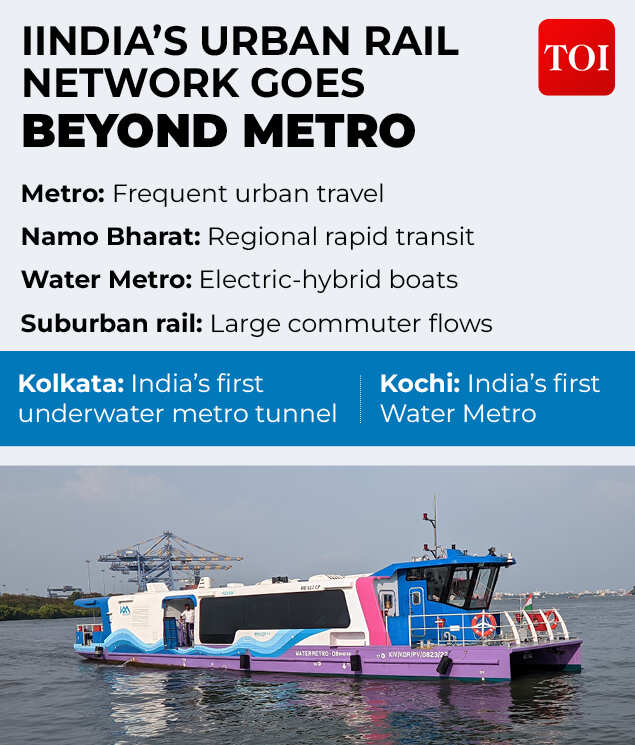
The broader transport architecture now includes systems with different purposes: metro for frequent urban travel, regional rapid transit for longer-distance connections, suburban rail for large commuter flows and buses for the wider feeder network.The challenge is making them work together.For a commuter, the usefulness of a metro line is not simply the number of kilometres built. It depends on whether they can reach the station easily, transfer smoothly, complete the last leg of the journey and do all of it at a reasonable cost.As India’s metro footprint grows, integration will therefore matter almost as much as network length.
The bigger challenge: Filling the trains
There is another measure of India’s metro boom that cannot be captured by kilometres of track.It is the passengers.Government figures show that daily metro ridership has grown from around 28 lakh in 2013-14 to more than 1.15 crore.
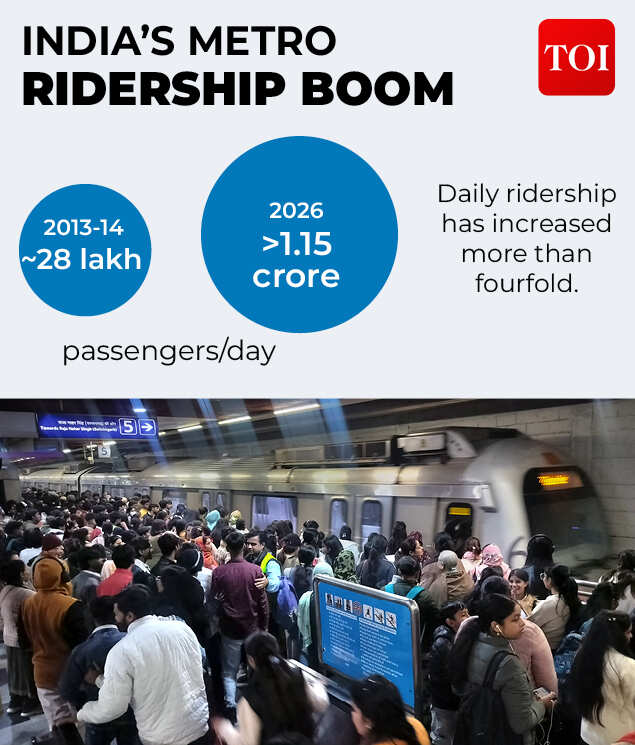
Established systems such as Delhi have seen particularly strong passenger volumes, while newer systems are still building their ridership base.That difference matters because metro rail is one of the most expensive forms of urban transport infrastructure to build.A new corridor can transform commuting patterns, but it also brings large construction, financing and operating costs. The government itself has recognised the need for metro systems to strengthen non-fare revenue, transit-oriented development and value-capture mechanisms.Some metro corporations continue to report losses, underlining the fact that expanding the network and making each system financially sustainable are two different challenges.This is particularly relevant as metro rail moves into smaller cities. A system designed for a city with millions of daily commuters cannot simply be replicated in a smaller urban centre and expected to generate the same passenger volumes.The future of India’s metro boom will therefore be measured not only by how many kilometres are inaugurated, but by how effectively those kilometres are used.
The urbanisation engine behind the boom
The reason India continues to need mass transit is straightforward: its cities are getting bigger, denser and more economically important.As urban populations rise, commuting distances increase and road congestion becomes more expensive in terms of time, fuel and productivity.Metro systems offer cities a way to move large numbers of people through relatively limited urban space. They can also connect residential areas with employment centres and support higher-density development around stations.That explains why metro rail has become an increasingly important part of India’s infrastructure strategy.The government has also increased annual budgetary support for metro infrastructure substantially, while domestic manufacturing has expanded the country’s ability to produce metro coaches and other equipment.Therefore, India is building a domestic ecosystem around metro construction, rolling stock, signalling, engineering and operations.
What comes next?
India’s metro network has expanded more than fourfold from its 2014 level. It has moved from around 248 km across five cities to 1,170 km across 26 cities, according to the latest figure cited by the Union minister.The next phase could be even bigger. Hundreds of kilometres are already under implementation, dozens of projects have been sanctioned and the metro map is spreading beyond the country’s biggest urban centres.But the final size of the network will depend on more than the number of projects announced or kilometres inaugurated.Construction timelines, financing, land availability, passenger demand and integration with buses, walking, cycling and other forms of public transport will determine how useful those kilometres become.The bigger transformation, however, has already happened.Now, as the network expands, the focus is not just on how many kilometres of track are being added. It’s also on how quickly it is growing, where it is expanding next and, most importantly, how many people are actually using it.