


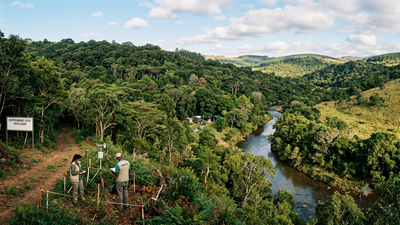
A small planting on a South African farm in 1976 was meant to solve an immediate problem: stopping floodwater from washing away soil and threatening livestock. The spekboom cuttings survived, but their story did not end there. More than four decades later, the same hillside had become a valuable example of how degraded land can begin to recover. Other vegetation returned, wildlife followed and scientists found evidence of changes beneath the soil as well. The old planting would eventually help shape a much larger restoration experiment across the Eastern Cape, where millions of spekboom cuttings were tested as a way to rebuild damaged landscapes.
The 1976 planting that quietly transformed a damaged hillside
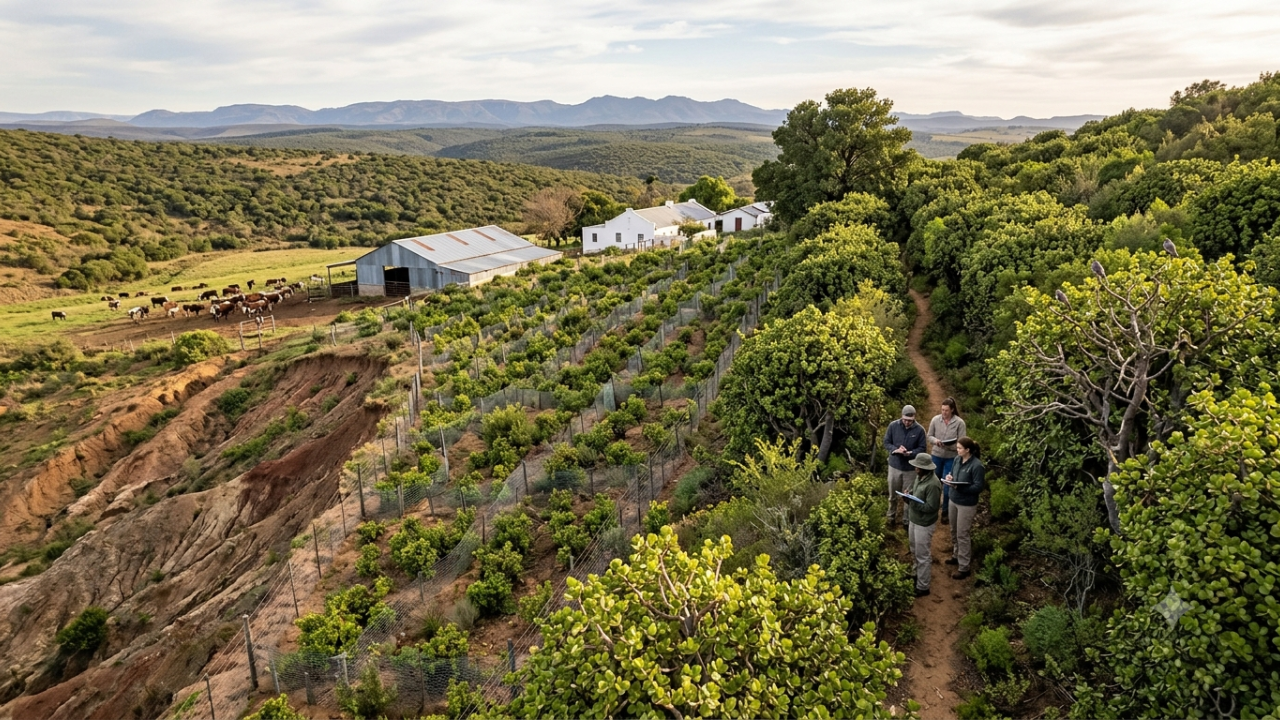
According to Global Issues, the planting took place in 1976 in the Kromport area of the Eastern Cape. Behind a farm barn was a steep slope, roughly 200 metres by 100 metres, where erosion and recurring floods had become a problem.The farmer planted cuttings of spekboom (Portulacaria afra), hoping the vegetation would slow the movement of water and protect his livestock. The cuttings established themselves on the degraded ground, and the flooding problem eased. What mattered later was that the plants were left in place.Some of the spekboom plants eventually became more than 40 years old. Other vegetation began to appear around them, while birds and wildlife returned to an area that had previously been heavily disturbed.
Spekboom’s unusual traits make it suited to restoration
Spekboom is a succulent native to South Africa. It has fleshy leaves and stems that allow it to cope with dry conditions, while its ability to grow from cuttings makes it relatively straightforward to propagate.That combination is useful in the Eastern Cape, where water can be scarce and degraded soils can be difficult places for plants to establish. As spekboom grows, it produces leaves that eventually fall and add organic material to the soil. Its roots contribute to the accumulation of carbon below ground, while the vegetation itself stores carbon.In mountainous areas, spekboom can grow on slopes and help slow runoff when rain arrives. Rather than allowing water to rush across bare ground and carry soil into rivers, vegetation gives some of that water a chance to soak into the landscape.
How centuries of grazing changed the Eastern Cape landscape
The significance of the experiment becomes clearer when looking at what once covered much of the Eastern Cape.Spekboom is a dominant component of the region’s subtropical thicket, a dense and diverse vegetation system that historically covered millions of hectares across the dry parts of the province.Much of that landscape was gradually degraded through intensive grazing, particularly by goats and sheep. Vegetation was removed faster than it could recover, leaving large areas exposed and increasingly vulnerable to erosion.Land that had once supported a dense thicket became much more open, with only scattered remnants of the original vegetation surviving. Jacket plum trees were among the species that could still be found in some degraded areas, providing clues about the ecosystem that had previously existed there.Ecologists studying the region estimated that more than 1.3 million hectares of severely degraded thicket could potentially be restored.The old Kromport planting offered an important clue about how that might be done.

A 40-year-old experiment changed the question
The remarkable thing about the original planting was not simply that the spekboom had survived.Other plants began returning. Wildlife came back. The vegetation started to resemble parts of the thicket that had once occupied the area. For scientists, the site offered something difficult to obtain through a conventional experiment: time.A restoration project lasting a few years can show whether plants survive. A site that has been growing for four decades can reveal much more about what happens afterwards.Scientists were able to examine carbon held in the plants, their roots and the surrounding soil. They could also observe changes in the wider vegetation community.The small farm site therefore became a reference point for a much larger question: could spekboom be used to help restore extensive areas of degraded thicket?
The experiment showed that planting was only the first step
In 2007, the South African government began establishing hundreds of demonstration plots across degraded thicket areas.Around 330 plots, each covering half a hectare, were planted with spekboom across a vast area of the Eastern Cape. The aim was to test whether the plant could establish itself under different environmental conditions and with different planting techniques. It was one of the country’s largest ecological restoration experiments.The results were encouraging, but they also showed that simply putting cuttings into the ground was not enough.Young spekboom plants needed protection from goats and other livestock while they became established. Fencing for several years could make the difference between a planting surviving and disappearing again. The lesson was fairly straightforward: restoration depended as much on protecting young vegetation as on choosing the right plant.
A farmer eventually faced the same problem
More than 30 years after the first spekboom planting, another South African farmer was confronting the consequences of degraded land.Pieter Kruger owned Zandvlakte in the Bavianskloof. His farm had suffered from erosion and vegetation loss, while water had become increasingly difficult to find.The situation eventually forced Kruger to abandon goat farming and take a different approach. He joined the government’s Working for Water programme, which was involved in restoring degraded landscapes and watersheds.Over the next three years, about 1,500 hectares of his farm were planted with millions of spekboom cuttings. More than 100 workers were involved in the restoration work.
Restored vegetation helped the farm withstand a major flood
The restored vegetation was put to the test during a major flood. Instead of water simply racing across the surface, the vegetation helped slow the runoff. More water could penetrate the soil, reducing the amount of topsoil being carried away.For Kruger, this was a practical demonstration of what restoration could mean on a working farm.The land was not being restored as an isolated nature reserve. It still had to function economically.His property later expanded into ecotourism, giving visitors an opportunity to see the restored landscape while creating another source of income.