


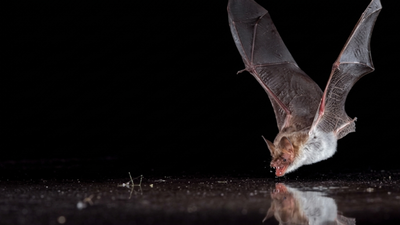
A thirsty bat sweeps over a pond, listens to the echoes returning from its surface and drops closer to drink. But what happens when that same acoustic signal comes from something that only looks like water to its echolocation system? Scientists have found that bats can be surprisingly easy to fool. In controlled experiments, smooth sheets made from materials such as plastic, metal and wood drew bats towards them as though they were shallow pools. The animals did not simply investigate and move on. They repeatedly lowered themselves towards the surfaces and attempted to drink, even though there was no water there.The behaviour was seen across numerous species, suggesting it was not an odd response from one unusually confused bat. Even young bats with no previous experience of lakes or rivers made the same mistake. The findings reveal just how strongly echolocation can shape a bat’s view of the world.
Scientists tested whether bats could mistake smooth surfaces for water
According to the European Commission, the experiments were carried out by scientists from the Max Planck Institute for Ornithology in Germany, led by Stefan Greif and Björn Siemers. Their interest was in how bats combine information from different senses when deciding what they are encountering during flight.For a bat using echolocation, water has a distinctive acoustic signature. A broad, calm surface reflects its high-frequency calls in a particular way, producing echoes that can be recognised as a potential drinking place. The researchers wondered whether the animals were responding so strongly to that acoustic pattern that they might mistake something else for water.They created artificial surfaces inside a large flight room and tested smooth plates alongside textured ones. The plates were made from different materials, including metal, wood and plastic. Under dim red light, the bats repeatedly went towards the smooth versions and attempted to drink from them.
11 more bat species showed the same mistaken response
The response was not limited to one type of bat. Three species tested on the different materials, the greater mouse-eared bat, Daubenton’s bat and the greater horseshoe bat, all showed the same basic tendency to approach smooth surfaces as if they were water.The material made some difference. Wooden plates attracted slightly fewer attempts from some individuals, but the distinction was relatively small. In one striking case, a Schreiber’s bat made as many as 100 drinking attempts within ten minutes.The scientists then widened the experiment to 11 more species. Their results suggested that the tendency was widespread among the insect-eating bats they examined rather than being an unusual quirk of a single species.That raised a more interesting question. If the bats could see, smell or touch the surface and still behaved as though it were water, which sense was actually controlling the decision?

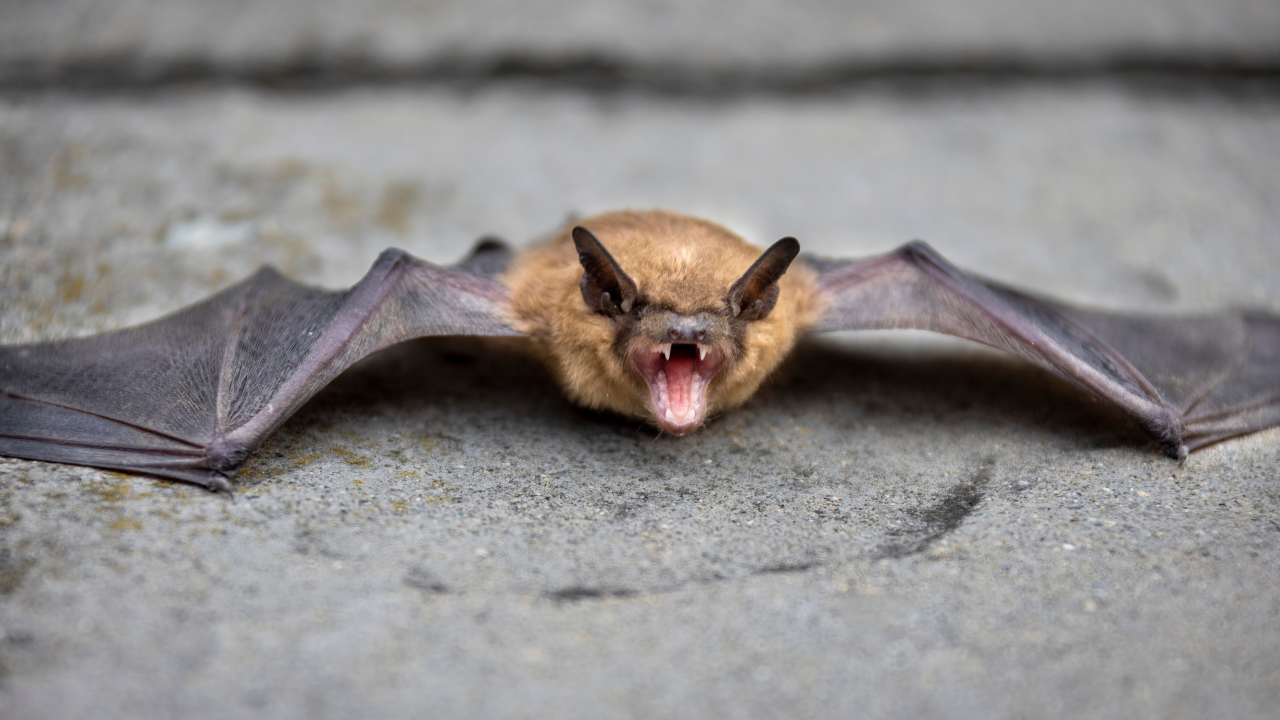
Man-made surfaces gave bats the wrong acoustic signal
The artificial surfaces provided information that should have contradicted the idea that water was present. They were solid objects, not pools, and some bats even landed on them by mistake. After taking off, however, they sometimes circled around and returned to make another attempt.The researchers also changed the setting. In one experiment, the smooth plate was placed on a garden table. Some bats flew beneath the table before coming back towards the plate and trying to drink from it. The surrounding physical cues did not appear to erase the acoustic signal they were following.The effect became stronger when the researchers removed visual information altogether. In complete darkness, the number of drinking attempts rose from roughly 100 to 160 in ten minutes, as reported.That result pointed towards a strong weighting of echolocation when the bats assessed whether a surface could be water. Their other senses were not necessarily ignored, but the echoes appeared to have the greater influence.
Young bats showed the same response without seeing water before
The researchers wanted to know whether this response developed through experience. A bat that had repeatedly visited ponds and streams might simply learn that a particular acoustic pattern usually means water.To test that possibility, they worked with young bats that had never encountered a lake or river. The juveniles were taken from a cave with their mothers and kept until they were capable of flying. When they were eventually presented with a smooth artificial surface, they attempted to drink from it on their first exposure.That finding changed the interpretation of the behaviour. If inexperienced bats responded in the same way as adults, the association did not appear to depend on having previously learned what real water looked or sounded like.Instead, the response seemed to be built into the way these animals process echoes.
Bats kept mistaking artificial surfaces for water
The experiment revealed an unusual trade-off in the bats’ sensory world. Smooth, horizontal expanses are rare in nature. Water is the main example, so treating a strong reflection from such a surface as a possible drinking place would normally be useful.Artificial materials can produce a similar echo, however. A sheet of metal or plastic may have nothing to offer a thirsty bat, but acoustically it can resemble the signal associated with a pool.The persistence of the response was particularly interesting because the bats did not immediately abandon the surface after discovering that it was solid. Some returned to it after flying away, apparently following the same acoustic information once again.It suggests that a sensory rule that works reliably in a natural environment can produce errors when an animal encounters an unusual man-made surface.
What happens outside the flight room
The experiments also left an open question about whether the same behaviour occurs frequently in the wild. Modern buildings and vehicles can create large, smooth surfaces that were absent from the environments in which these sensory responses evolved.Skylights, glass structures, car roofs and other flat surfaces could potentially reflect echolocation in ways that resemble water. The researchers suggested that bats might investigate such places, although their normal familiarity with established drinking sites could limit how long they persist.Many bats show strong site fidelity, returning repeatedly to known locations where water is available. A bat that encounters an unfamiliar surface may therefore have other information to fall back on, even if its first acoustic impression is misleading.Whether artificial surfaces regularly cause bats to waste time or energy remains uncertain. The flight-room experiments demonstrated the sensory response clearly, but observations in natural settings would be needed to establish how often the same mistake occurs and whether it has any meaningful consequences for wild bat populations.